
News
Optimising for AI Search: How AIO, AEO and GEO Targeting Are Redefining SEO Strategy
Traditional SEO has always been about keywords, backlinks, and rankings. But in 2025, those tactics alone no longer guarantee visibility. The rise of AI-driven search — from Google’s Search Generative Experience (SGE) to conversational assistants like ChatGPT, Perplexity, and Microsoft Copilot — is redefining how people discover, evaluate, and choose brands online.
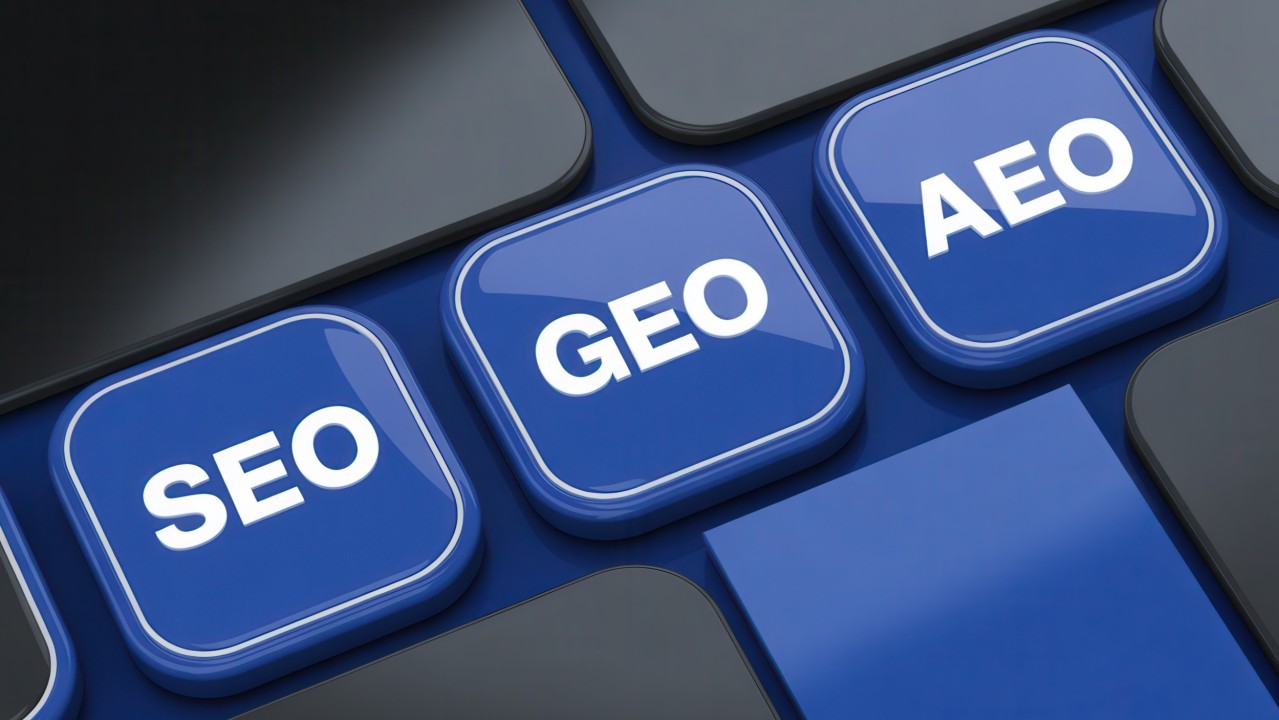
Search is becoming more human, more local, and more context-aware. That means your SEO strategy must evolve too — from simple optimisation to AIO (Artificial Intelligence Optimisation), AEO (Answer Engine Optimisation), and GEO (Geographical AI Optimisation).
In this article, we’ll explore how these emerging approaches are transforming SEO, what practical steps business owners and marketing directors can take today, and how to future-proof your online presence for the next era of search.
Search is changing – and faster than most businesses realise.
From Keywords to Context: The Shift to AI Search
For years, SEO revolved around identifying target keywords and building backlinks. While those fundamentals still matter, AI search has changed the rules.
AI-powered engines don’t just match words — they understand meaning, intent, and relationships. They interpret what the user really wants, not just what they typed.
For example: A user searching for “best accountants for small business near me” will now receive a personalised, AI-curated answer combining location, reviews, and context — not just a list of links.
That’s why future SEO is about optimising for understanding, not just indexing.
What Is AIO (Artificial Intelligence Optimisation)?
AIO focuses on making your website and content machine-readable and semantically rich, ensuring that AI models can interpret, trust, and surface your information in conversational search results.
The Core Principles of AIO
- Structured Data Everywhere Use schema markup to help AI understand your pages — from products and FAQs to reviews and services.
- Entity-Based SEO AI systems think in entities — people, places, companies, and concepts.
- Machine-Readable Content
AIO is about clarity and context, not just keywords.
What Is AEO (Answer Engine Optimisation)?
AEO is the process of optimising your content so that AI answer engines — like Google SGE or Bing Copilot — select your brand’s information when generating summaries or responses.
How AEO Works
AI systems scan multiple sources, extract key facts, and generate a summarised answer. To appear in these summaries, your content must:
- Be structured for direct answers (e.g. use question-based headings).
- Be factually accurate and up to date.
- Come from a source that demonstrates expertise and credibility (E-E-A-T).
Practical AEO Techniques
- Use “People Also Ask” questions in your headings and subheadings.
- Include short, snippet-friendly answers (40–60 words) below each one.
- Create FAQ sections with schema markup.
- Ensure your About page and author bios show real expertise.
Think of AEO as positioning your brand to answer AI, not just rank for Google.
What Is GEO (Geographical AI Optimisation)?
AI search engines now personalise results based on location, behaviour, and local relevance — even when users don’t explicitly mention their location.
GEO is the evolution of local SEO. It’s about aligning your brand presence with the way AI models interpret geography and proximity.
GEO Optimisation Strategies
- Maintain a Consistent NAP (Name, Address, Phone)
- Optimise for Local Intent
- Use AI-Friendly Local Content
- Encourage Local Reviews AI systems heavily prioritise review signals. Respond to every review and include contextual keywords in responses.
GEO optimisation ensures your business isn’t just visible — it’s relevant to every nearby searcher.
How AIO, AEO, and GEO Work Together
AIO (Artificial Intelligence Optimisation), AEO (Answer Engine Optimisation), and GEO (Geographical Engine Optimisation) are complementary strategies that work in unison to form the modern backbone of intelligent search optimisation.
As search engines increasingly rely on AI-driven understanding, context, and personalisation, these three elements ensure your content not only ranks well but is also correctly interpreted, positioned, and localised for your target audience. Rather than treating them as isolated tactics, successful digital strategies weave them together into a unified approach that mirrors how search algorithms now process and prioritise information.
AIO focuses on helping artificial intelligence interpret your content with precision. By applying structured data, entity linking, and semantic clarity, AIO makes it easier for search engines to understand who you are, what your content covers, and how it connects to broader topics. This foundation of machine-readable meaning ensures that your pages are accurately categorised and surfaced in relevant contexts, improving both visibility and authority in search results.
AEO then builds on this by positioning your content as the most suitable and direct answer to user queries. Through tactics like Q&A formatting, snippet-ready content, and demonstrable expertise, AEO aligns your messaging with how users now search — using conversational prompts and natural language questions. The result is a higher likelihood of appearing in featured snippets, AI summaries, and voice search responses, all of which are central to modern discovery.
Finally, GEO ensures that your brand and content are contextually relevant to specific locations. Accurate local data, optimised regional content, and clear proximity signals allow AI-driven engines to connect your offerings with nearby searchers. This is especially vital for businesses serving defined areas or operating from physical locations. Together, AIO, AEO, and GEO form an integrated visibility framework that mirrors how search engines think, enabling brands to appear, engage, and convert more effectively across every layer of intelligent search.
The Role of Conversational Intent
AI-driven search is conversational. People don’t type keywords — they ask questions like they’re speaking to a person.
Your content must mirror that natural language.
Example Transformation
❌ Old SEO: “Best marketing agency Milton Keynes”
✅ AI Search: “Which digital marketing agencies in Milton Keynes have strong SEO and social media results?”
How to Optimise for Conversational Intent
- Use “who, what, why, how” questions throughout content.
- Include clear, concise answers with supportive context.
- Add examples and scenarios that mimic human reasoning.
The more your content sounds like how your customers talk, the more likely AI is to surface it as relevant.
Why Structured Data Is the Backbone of AI SEO
Structured data bridges the gap between human content and machine interpretation. It helps AI systems categorise, reference, and trust your site’s information.
Essential Schema Types
- Organisation – defines your company details and social links.
- Product/Service – lists pricing, reviews, and availability.
- FAQ – improves chances of being featured in AI-generated summaries.
- LocalBusiness – adds geographic and contact data for GEO.
- Review – signals credibility and engagement.
Implement schema consistently using JSON-LD format and validate it through Google’s Rich Results Test.
Structured data is the “language” AI understands — and ignoring it means becoming invisible in AI search results.
Voice and Multimodal Search: The Next Layer
AI search doesn’t stop with text. Voice search and image recognition are reshaping how users find information.
- Voice Search – conversational, often question-based queries (e.g. “Where can I buy eco-friendly office furniture near me?”).
- Image Search – users upload or snap a photo to find similar products.
Optimise for both by:
- Including descriptive alt text and metadata.
- Writing content in natural, conversational language.
- Ensuring local signals appear in voice search results.
Voice and visual AI searches require content that’s rich, descriptive, and contextual.
The Role of Content Depth and Topical Authority
AI search engines prefer authoritative, in-depth content. Surface-level blogs or keyword-stuffed pages are no longer competitive.
To rank in AI-driven results, your brand needs topical authority.
Build Authority Through:
- Pillar Content – long-form, educational articles that cover a core topic in depth.
- Cluster Pages – supporting posts that link back to the main pillar.
- Consistent Internal Linking – showing logical relationships between topics.
- Up-to-Date Insights – AI models favour recent, factual information.
Example: If you’re a marketing agency, you might create a Digital Marketing Strategy Hub, then link related pages on SEO, PPC, Social Media, and Analytics — creating a semantic network of expertise.
The Future of Paid Search in an AI World
AI isn’t just changing organic search — it’s revolutionising paid search too.
1. Predictive Targeting
Machine learning already anticipates intent and adjusts bids in real time. Expect more AI-driven campaign automation, where targeting adapts dynamically to user behaviour and context.
2. Generative Ad Copy
Google’s Performance Max campaigns now use AI to write headlines and descriptions. While efficient, it’s vital to review for brand tone and accuracy.
3. Integrated Data Ecosystems
AI thrives on first-party data. Linking your CRM, analytics, and ad platforms allows AI to predict the highest-converting customer segments automatically.
Paid and organic search strategies will increasingly merge under the shared goal of AI-driven visibility and personalisation.
Common Mistakes Businesses Make
- Relying on Old SEO Tactics Keyword stuffing and backlinks alone won’t earn AI trust.
- Ignoring Structured Data Without schema, your site is invisible to AI understanding.
- Failing to Demonstrate Expertise Content written by anonymous authors won’t rank in AI-driven environments.
- Neglecting Local Relevance Even global brands need geo-optimised signals.
- Not Updating Content Regularly AI prefers current, accurate, and frequently refreshed information.
Preparing for the Future: SEO in 2026 and Beyond
AI search will continue to evolve rapidly. Expect:
- AI-curated search results that summarise and cite your brand as a trusted source.
- Dynamic localisation, where results adapt in real time based on user movement.
- Integration with wearable devices — search results delivered via voice, AR, or AI assistants.
The foundation for success remains the same: 🧠 Expertise. 🔍 Clarity. 📍 Relevance.
Brands that invest now in AIO, AEO, and GEO will lead the next generation of search visibility.
Final Thoughts
Search is no longer about algorithms — it’s about understanding.
AI search models want context, credibility, and clarity. They reward brands that communicate like humans and structure like machines.
If your SEO strategy still revolves around chasing rankings, it’s time to evolve. Future visibility depends on becoming the trusted answer, not just a listed result.
Because in the era of AI-driven discovery, your website doesn’t need to shout louder — it just needs to speak the language of intelligence.













The Ultimate Social Media Guide
With the ever-growing power of social media, we use the latest techniques, video, and animation software to craft eye-catching social media assets that make your brand pop. Our designers, wielding Adobe Creative tools, create distinctive animations and graphics to illuminate your brand story and highlight your products or services. Want a unique design? No problem – we also offer bespoke designs to match your brand aesthetic.