News
How to Build a Digital Marketing Strategy That Generates Leads, Not Just Traffic
Why successful digital marketing requires your website, SEO, PPC, social media, content and email to work together around measurable business objectives
Generating website traffic has become one of the most familiar objectives in digital marketing. Businesses invest in search engine optimisation, paid advertising, social media campaigns and content marketing, often measuring success by the number of people visiting their website.
More visitors can certainly create more opportunities. However, traffic alone does not pay the bills, build customer relationships or guarantee business growth. A website attracting thousands of visitors every month can still struggle to generate meaningful enquiries, while another business with significantly less traffic may consistently attract valuable customers.
The difference often comes down to strategy.
Many organisations approach digital marketing as a collection of separate activities. SEO is responsible for rankings, PPC generates clicks, social media builds engagement and email distributes newsletters. The website sits somewhere in the middle, receiving visitors from each channel but not necessarily providing a clear route towards becoming a customer.
This fragmented approach can produce impressive marketing reports without delivering equally impressive commercial results.
A genuinely effective digital marketing strategy needs to connect every channel around a shared purpose. It should attract the right audience, answer their questions, demonstrate expertise, build confidence and make it easier for potential customers to take the next step.
The objective is not simply to generate more traffic.
Start with business objectives, not marketing channels
One of the most common mistakes businesses make is choosing marketing activities before defining what those activities need to achieve. A company decides it needs more SEO, a stronger LinkedIn presence or a larger Google Ads budget because competitors are investing in those areas or because a particular channel appears to be performing well elsewhere.
However, marketing channels are tools rather than objectives. The correct starting point is understanding what the business wants to achieve commercially. That might involve generating more enquiries for a profitable service, increasing sales within a particular industry, entering a new geographic market or improving the quality of opportunities reaching the sales team.
These objectives should influence every subsequent marketing decision. A business seeking high-value commercial contracts may need a very different strategy from an online retailer looking to increase transaction volume. The first might prioritise thought leadership, technical content, targeted LinkedIn activity and relationship development. The second may benefit more immediately from product search visibility, shopping advertising, email automation and conversion optimisation.
A strong strategy therefore begins with commercial clarity. What does growth look like? Which products or services contribute the most value? What type of customer does the business want to attract? How many additional opportunities are required, and what proportion would realistically need to become customers?
Without these answers, it becomes difficult to judge whether marketing activity is successful.
Understand the difference between traffic and qualified demand
Not every website visitor represents a potential customer. Some people are researching a subject for educational purposes, others may be looking for employment and some may be searching for products or services the organisation does not provide.
This distinction matters because marketing activity can increase traffic without improving commercial performance. An article answering a broad industry question might attract thousands of visitors, but relatively few may have the need, budget or authority to purchase the company’s services.
By contrast, a detailed service page addressing a specific commercial problem may attract fewer visitors but generate more relevant enquiries. The smaller audience could represent significantly greater business value.
Businesses should therefore distinguish between generating attention and generating qualified demand. Both can be useful, particularly when building brand awareness and long-term authority, but they serve different purposes.
A well-designed strategy considers the quality of visitors alongside their volume. It asks whether the right people are discovering the organisation, whether the content matches their needs and whether the website gives them a reason to continue towards a commercial conversation.
Define the customers you actually want to attract
Effective lead generation depends on understanding the intended customer. Yet many businesses describe their target audience in terms so broad that almost any organisation could qualify.
A company might say it wants to reach UK businesses, marketing managers or manufacturers. Those descriptions provide a starting point, but they do not explain the circumstances that make someone a particularly valuable prospect.
A stronger approach considers industry, company size, location, business challenges, buying triggers and commercial suitability. A software provider might achieve its strongest results with medium-sized manufacturers struggling to connect operational systems. A specialist engineering business may be particularly valuable to customers operating equipment where downtime creates substantial financial risk.
Understanding these differences helps marketing become more relevant. SEO can target specific problems, PPC can focus on high-intent searches and content can address the concerns that influence purchasing decisions. Social media and email can reinforce the same messages rather than relying on broad promotional statements.
The more clearly a business understands its ideal customers, the easier it becomes to create marketing that attracts the right people instead of simply attracting more people.
Map the customer journey before choosing the content
Most customers do not move directly from discovering a business to submitting an enquiry. Particularly in B2B markets, purchasing decisions may involve weeks or months of research, internal discussion, supplier comparisons and budget approval.
A potential customer might initially encounter a useful LinkedIn post, visit an educational article, return several weeks later through Google and eventually read a case study before contacting the business. Another may discover the company through paid advertising but need further reassurance before committing to a conversation.
A successful digital marketing strategy should recognise these different stages. Early-stage customers need education and an understanding of possible solutions. Those comparing suppliers require evidence, differentiation and detailed service information. People ready to enquire need clear calls to action, straightforward contact options and confidence that the organisation can meet their requirements.
When channels are planned independently, these connections are often missing. Social media generates awareness without providing useful next steps. Articles attract visitors but do not connect to relevant services. Paid advertising drives traffic towards pages that fail to answer important questions.
Mapping the journey helps businesses design marketing around how customers actually make decisions rather than how internal teams happen to organise their work.
Your website should be the centre of the lead-generation strategy
A business can invest heavily in SEO, PPC, social media and email, but if its website fails to convert relevant visitors, much of that investment will be wasted.
The website should therefore be treated as a commercial asset rather than simply a digital brochure. Its role is to help customers understand what the organisation does, whether its services are relevant and why it should be trusted.
Clear messaging is essential. Visitors should not need to interpret vague claims about innovation, excellence or delivering solutions before understanding the business. Service pages should explain the problems being solved, who the service is designed for and what customers can expect from the process.
The website should also provide evidence. Case studies, testimonials, customer examples, accreditations, professional photography and expert profiles can all reduce uncertainty. Strong navigation and internal linking should make it easy for visitors to move between educational content, services and supporting proof.
Most importantly, the website should offer clear next steps. A customer ready to discuss a project should be able to enquire without unnecessary friction, while someone still researching should have opportunities to explore additional information.
SEO should attract relevant customers, not just improve rankings
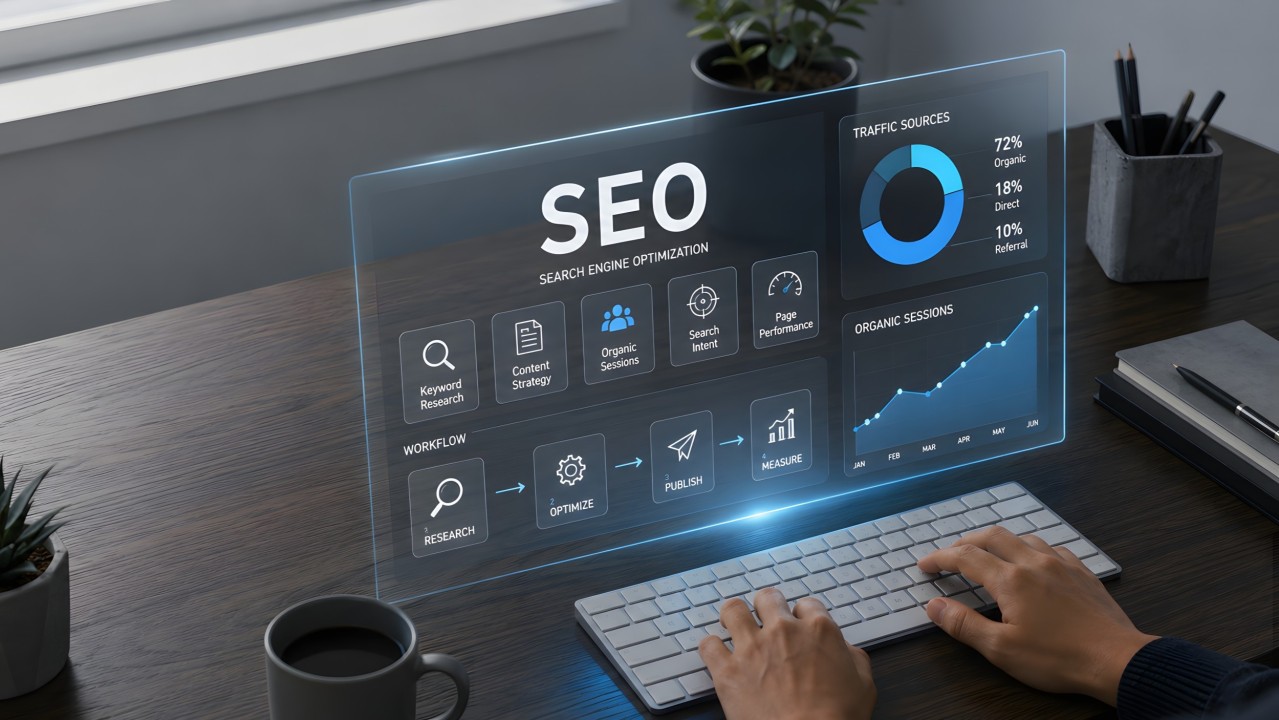
Search Engine Optimisation remains one of the most valuable long-term digital marketing disciplines because it allows businesses to become visible when customers are actively researching relevant subjects.
However, an effective SEO strategy should begin with search intent rather than keyword volume alone. A phrase generating thousands of monthly searches may offer little commercial value if most users are looking for something unrelated to the business’s services.
The strongest approach combines visibility for relevant services with useful content addressing the wider questions customers ask before making purchasing decisions. Service pages can target commercial searches, while educational guides, comparisons and specialist articles help establish expertise earlier in the journey.
These resources should be connected. An article explaining a common operational challenge might naturally link towards a service that helps solve it, while the service page can reference relevant case studies and deeper technical guidance.
SEO should also support a broader understanding of digital authority. As customers increasingly use AI-assisted research, clear information, topical depth, credible evidence and structured content can contribute towards visibility across traditional search, answer engines and generative platforms.
The objective should not be to rank for as many keywords as possible. It should be to become discoverable and credible for the searches that matter to the business.
PPC should capture demand and support the wider strategy
Paid advertising offers something that organic marketing cannot always provide immediately: the ability to place a business in front of targeted audiences quickly.
Google Ads can be particularly effective when customers are already searching for a product or service. LinkedIn advertising may help reach specific professional audiences, while other paid platforms can support awareness, remarketing and e-commerce activity.
However, the effectiveness of PPC depends on what happens after the click. A well-targeted campaign can still underperform if the landing page is unclear, the offer is weak or the enquiry process creates unnecessary friction.
PPC should therefore be developed alongside website and conversion strategy. Advertising messages should match the information visitors encounter after clicking, and landing pages should address the particular problem or requirement that motivated the search.
Paid advertising can also provide useful insight for other channels. Search terms generating qualified enquiries may reveal opportunities for SEO content, while advertising tests can help identify messages that resonate with customers.
The strongest approach treats PPC as part of a coordinated acquisition strategy rather than an isolated method of purchasing website traffic.
Social media should create familiarity before the enquiry
Social media rarely follows a simple relationship between a post and a sale. A potential customer may engage with a company’s content for months before a commercial requirement arises.
This does not make social media ineffective. It means its role within the customer journey needs to be understood.
Platforms such as LinkedIn can help businesses demonstrate expertise, share customer stories, introduce employees and build relationships with relevant audiences. Educational posts, thought leadership, video and behind-the-scenes content can gradually create recognition and confidence.
A business that consistently publishes useful insights may become familiar to potential customers long before they need its services. When a requirement eventually appears, that familiarity can influence which organisations are considered.
However, social media should also provide routes towards deeper engagement. Relevant posts can introduce articles, case studies, webinars, service pages and other resources. This helps move audiences from passive awareness towards greater understanding.
The objective is not simply to accumulate followers or reactions. It is to build relationships that may eventually contribute towards qualified opportunities.
Content marketing should connect every stage of the journey
Content is often described as a separate marketing channel, but it is more useful to think of it as the material that connects several channels.
An educational article can attract visitors through Google, provide source material for social media, support a newsletter and answer questions during a sales conversation. A case study can strengthen a service page, improve a PPC landing page and provide evidence for LinkedIn outreach.
This interconnected approach creates greater value from the expertise businesses already possess. Rather than producing unrelated content for each platform, organisations can develop substantial resources and adapt them intelligently for different audiences and formats.
The strongest content begins with genuine customer needs. Sales teams know which questions appear during meetings, customer service teams understand recurring concerns and technical specialists can explain the problems they solve every day.
Turning that knowledge into useful articles, videos, guides and case studies creates a foundation for both discovery and trust.
Content should not exist simply to fill a calendar. Every significant asset should have a purpose within the wider customer journey.
Email marketing should turn temporary attention into ongoing relationships
One of the limitations of relying entirely on search and social media is that businesses do not control when audiences will encounter them again.
Someone may discover an article through Google, find it useful and leave without returning. A LinkedIn follower may not see the next post because of how the platform distributes content.
Email provides an opportunity to develop a more direct relationship with people who have chosen to receive ongoing communication.
A useful newsletter can keep customers and prospects informed through educational articles, industry insights, customer stories and relevant company updates. This is particularly valuable in B2B markets where purchasing decisions can take considerable time.
Email can also support more specific journeys. Someone downloading a technical guide may appreciate related information, while an existing customer might benefit from product updates or practical advice.
The objective should be to nurture relationships rather than repeatedly push sales messages. A permission-based audience that consistently receives useful communication can become a valuable long-term business asset.
Conversion optimisation turns marketing investment into more opportunities
Many businesses respond to disappointing lead generation by increasing marketing spend. They invest in additional advertising, publish more content or attempt to attract more website visitors.
However, if the existing website is converting poorly, increasing traffic may simply increase the amount of potential value being lost.
Conversion Rate Optimisation focuses on improving what happens after someone arrives. This might involve clarifying the proposition, strengthening calls to action, simplifying forms, improving mobile usability or adding more persuasive evidence.
Small improvements can have meaningful commercial consequences. A website attracting 5,000 relevant visitors per month with a 1% enquiry conversion rate generates 50 enquiries. If improvements increase that rate to 2%, the same traffic produces 100 enquiries.
Of course, conversion volume alone is not the objective. The quality of those enquiries also matters. A shorter form might generate more submissions but reduce qualification, while a more detailed enquiry process could produce fewer but better opportunities.
Conversion optimisation should therefore be connected with sales feedback and commercial outcomes, not simply the percentage of visitors completing a form.
Marketing and sales need to agree on what a good lead looks like
A digital marketing strategy cannot be properly evaluated if marketing and sales have different definitions of success.
Marketing may report an increase in enquiries while sales complains that most prospects are unsuitable. The marketing team sees growth, but the commercial team sees additional administration.
This often happens when lead-generation objectives focus on volume without considering qualification.
Businesses should establish a shared understanding of what constitutes a valuable opportunity. Relevant factors may include company size, industry, location, budget, timescale, requirement and purchasing authority.
That information can then influence campaign targeting, content, forms and reporting.
Regular communication between marketing and sales is essential. Sales teams should provide feedback about lead quality, common objections and the reasons opportunities are won or lost. Marketing can use those insights to refine messaging and attract better-matched prospects.
The strongest strategies create a feedback loop in which marketing becomes progressively better at generating the opportunities the business actually wants.
CRM and analytics should connect the customer journey
One of the biggest challenges in digital marketing is understanding which activities contribute towards commercial results.
A customer may discover the business through organic search, return through a social media post, subscribe to a newsletter and eventually submit an enquiry after clicking a paid advert.
If reporting only credits the final interaction, much of the wider journey becomes invisible.
Analytics and CRM integration can help businesses develop a more complete understanding of how customers engage with marketing before becoming sales opportunities.
This does not mean every interaction can be attributed perfectly. Privacy restrictions, multiple devices, offline conversations and longer buying journeys create unavoidable limitations.
However, businesses should still aim to connect marketing data with enquiry quality, pipeline progression and customer acquisition wherever practical.
The purpose is not to create the most complicated dashboard possible. It is to provide enough useful information to make better decisions about where marketing resources should be invested.
Measure cost per customer, not simply cost per click
A low cost per click may appear attractive, but it provides little insight into commercial performance without understanding what happens afterwards.
Similarly, a campaign generating leads at £30 each is not necessarily more effective than one generating leads at £100.
Imagine one campaign generates 100 enquiries at £30 each, but only two become customers. The advertising cost per acquired customer is £1,500.
Another campaign generates 30 enquiries at £100 each, but six become customers. The advertising cost per acquired customer is £500.
Both campaigns have spent £3,000, but the second has produced three times as many customers.
This simplified example demonstrates why lead quality and sales conversion matter so much. Businesses should also consider customer value, profitability, sales costs and retention when evaluating return on investment.
The most commercially useful question is rarely, “How cheaply can we generate traffic?”
It is, “How efficiently can we acquire profitable customers?”
Brand strength can improve every acquisition channel
Branding is sometimes treated as a separate activity from lead generation. In reality, brand recognition and trust can influence performance across almost every digital channel.
A recognised organisation may find that customers are more willing to click its search results, engage with its content or respond to its advertising. A consistent visual identity and clear proposition can also make the website feel more credible.
Brand strength develops through repeated experiences. Professional design, useful content, customer stories, expert commentary, photography, video and consistent communication all contribute towards how people perceive the organisation.
This matters particularly when several suppliers offer apparently similar services. Customers are not simply comparing features and prices. They are assessing credibility, reliability and the risk involved in making the wrong decision.
A lead-generation strategy should therefore invest in building confidence as well as attracting attention.
AI should make the strategy more effective, not more fragmented
Artificial intelligence is creating opportunities across digital marketing. Businesses can use AI to support research, analyse data, repurpose content, improve automation and develop more personalised customer experiences.
AI is also changing how customers discover and compare suppliers. Conversational search, AI-generated summaries and recommendation systems can influence purchasing decisions before someone visits a website.
However, adding more AI tools does not automatically create a better marketing strategy.
The fundamentals remain the same. Businesses need to understand customers, communicate a clear proposition, demonstrate expertise and provide a useful journey towards becoming a customer.
AI should support those objectives rather than become another disconnected activity. It may help identify content opportunities, improve campaign analysis or make lead nurturing more efficient, but human judgement remains essential.
The strongest organisations will use AI to improve the connections between marketing activities rather than simply increase the volume of content and automation.
Build a connected marketing system rather than separate campaigns
The real opportunity lies in connecting the individual disciplines.
SEO helps relevant customers discover the business when they are researching a problem. PPC can capture existing demand and introduce the organisation to targeted audiences. Social media builds familiarity and relationships, while content provides the expertise and evidence that supports those interactions.
The website brings these activities together, helping visitors understand the proposition and move towards an appropriate next step. Email allows the organisation to continue communicating with people who are not yet ready to buy.
Conversion optimisation improves the effectiveness of the entire journey, while analytics and CRM data help the business understand which activities contribute towards meaningful outcomes.
Each channel has a different role, but they should support the same commercial objectives.
When these connections are missing, businesses may generate traffic without creating enough opportunities. When they work together, marketing becomes a coordinated process rather than a collection of independent tasks.
Prioritise improvements rather than trying to do everything at once
Building an integrated digital marketing strategy does not mean every business needs to invest heavily in every available channel.
A smaller organisation may achieve better results by concentrating on a strong website, commercially relevant SEO, targeted PPC and a consistent LinkedIn presence before expanding into more sophisticated automation or additional platforms.
Another business may already have substantial organic visibility but struggle to convert visitors into enquiries. Its priority may be website optimisation rather than increasing traffic.
The correct investment depends on the existing position and the commercial opportunity.
Businesses should therefore identify the weakest or most valuable points within their customer journey. Are they attracting the wrong audience? Is the proposition unclear? Do visitors lack evidence? Are forms creating friction? Are good enquiries being lost through poor follow-up?
Solving the most important problem first is often more effective than spreading resources thinly across every marketing discipline.
Review performance and improve continuously
A digital marketing strategy should not be created once and then followed unchanged for several years.
Customer behaviour evolves, competitors improve and commercial priorities change. Campaign performance provides new information, while sales feedback reveals which enquiries are genuinely valuable.
Regular reviews should therefore consider both activity and outcomes. Which channels are attracting relevant audiences? Which content is influencing enquiries? Where are visitors leaving the website? Which campaigns are producing qualified opportunities?
These insights should influence the next stage of work.
Sometimes the right decision will be to increase investment in a successful channel. At other times, it may involve improving existing content, changing campaign targeting or simplifying the website journey.
Continuous improvement is what turns marketing from a collection of recurring expenses into a progressively stronger business capability.
Build Marketing Around Customers, Not Channels
Generating more website traffic is relatively easy to identify as a marketing objective.
Generating more profitable customers is a more meaningful ambition.
The difference requires businesses to think beyond individual platforms and consider how customers discover, research, evaluate and choose suppliers.
SEO, PPC, social media, content marketing and email all have important roles to play. However, none should operate independently from the website, the sales process or the wider commercial strategy.
A strong digital marketing approach attracts relevant people, provides useful information, demonstrates credibility and makes it easier for customers to take the next step.
It also recognises that not every visitor is ready to buy immediately. Some need education, others require evidence and many benefit from repeated exposure before they feel confident enough to enquire.
The objective is to create a connected journey that supports all of these needs.
So instead of asking:
Ask:
That question changes how marketing is planned, delivered and measured.
Because the most effective digital marketing strategy is not necessarily the one generating the most traffic.
It is the one consistently turning the right attention into the right opportunities—and those opportunities into sustainable business growth.
Scott Jones is the CEO of a full service, leading and award winning SEO & Digital Marketing Agency. 123 Internet® – Digital Marketing Growth Agency support a local, national and international client base with AI-led digital marketing strategy, web design and e-commerce, creative branding, design and print, social media, lead generation, SEO/PPC, AI Search Optimisation and videography focused on ROI.
For more information about our services or advice on how to improve your online marketing activities please reach out and connect with us via our website or our social media channels.