News
Why Traditional SEO Alone Is No Longer Enough for Modern Businesses
How AI search, user behaviour, and evolving digital expectations are reshaping what visibility really means
For many years, SEO followed a relatively predictable formula.
Businesses researched keywords, optimised pages, built backlinks, and aimed to improve rankings in search engines. Success was measured largely through organic traffic growth, keyword position, and click-through rates.
That approach worked because search itself was relatively straightforward.
Users searched using short phrases, search engines returned lists of links, and websites competed for visibility within those rankings. The objective was simple: appear higher than competitors and attract more clicks.
But search is no longer behaving in the same way.
AI-driven search experiences, conversational discovery, answer engines, and evolving user expectations are fundamentally changing how people find information online. At the same time, search engines are becoming far more sophisticated in how they evaluate quality, authority, and relevance.
As a result, businesses relying solely on traditional SEO strategies are increasingly finding that rankings alone are no longer enough to drive sustainable growth.
Modern visibility requires something broader.
It requires businesses to move beyond SEO as a standalone tactic and embrace a more integrated strategy built around authority, trust, experience, and understanding.
The Search Landscape Has Fundamentally Changed
Traditional SEO was built around search engines acting as retrieval systems.
Users entered a query, and search engines returned a list of websites that appeared relevant to that phrase. Optimisation largely revolved around helping pages rank for those queries.
Today, search engines and AI platforms are becoming interpretation systems rather than simple retrieval tools.
Platforms powered by AI increasingly attempt to answer questions directly rather than simply directing users elsewhere. Search engines analyse context, interpret intent, summarise information, and surface recommendations based on broader signals than keywords alone.
This changes what visibility means.
Businesses are no longer competing only for rankings. They are competing for inclusion within AI-generated answers, summaries, and recommendation systems.
And that requires a different approach entirely.
Keywords Still Matter — But They Are No Longer the Strategy
One of the biggest misconceptions in modern digital marketing is that keywords no longer matter.
They do.
Search behaviour still begins with language, and optimisation remains important. However, keywords are now only one part of a much larger system.
Traditional SEO often focused heavily on targeting individual phrases. Pages were created specifically to rank for isolated terms, sometimes with limited consideration for broader context or user value.
Modern search systems evaluate far more than keyword usage.
They assess:
- topical depth
- semantic relationships
- authority within a subject area
- content structure and clarity
- user engagement signals
- brand trust and recognition
This means keyword optimisation alone is no longer enough to establish visibility.
Businesses must now demonstrate understanding rather than simply relevance.
The Rise of AI Search Is Changing User Behaviour
AI-driven search tools are changing how users interact with information.
Increasingly, users receive summarised answers before they ever visit a website. Research that previously required multiple searches and website visits can now happen within conversational AI interfaces.
This alters the customer journey significantly.
Users arrive on websites with greater context and stronger intent because much of the discovery process has already happened elsewhere. As a result, websites are no longer simply information sources — they are becoming trust validation and decision-making environments.
Businesses relying solely on traditional SEO metrics may therefore misinterpret what is happening.
Traffic may decline in some areas while lead quality improves.
The businesses succeeding in this environment are not necessarily those attracting the most clicks. They are the ones building the strongest authority and trust signals.
Authority Has Become More Important Than Ranking
Search engines and AI systems are increasingly designed to prioritise reliable sources.
This means authority has become one of the most important factors influencing digital visibility.
Authority is not created through technical SEO alone.
It is built through consistent expertise, strong topical coverage, external validation, and clear brand positioning. Businesses that publish shallow, keyword-focused content without demonstrating real understanding are finding it harder to compete.
Meanwhile, brands investing in:
- educational content
- thought leadership
- topical ecosystems
- clear positioning
- consistent expertise
are strengthening their visibility across both traditional and AI-driven search environments.
Modern search rewards trustworthiness as much as optimisation.
Content Must Be Built for Humans and Machines
Traditional SEO often encouraged content written primarily for algorithms.
This resulted in pages overloaded with repetitive keywords, unnatural phrasing, and thin informational value. While search engines have evolved significantly since then, many businesses still operate with outdated content strategies.
Modern content must serve two audiences simultaneously:
- human readers
- AI systems interpreting meaning and context
This requires a different style of communication.
Content must now be:
- semantically clear
- logically structured
- contextually rich
- genuinely useful
- easy for AI systems to extract and interpret
Importantly, content that performs well in AI-driven search environments often performs better for humans as well.
Clarity and usefulness benefit both audiences.
User Experience Now Influences Visibility
SEO used to focus heavily on what happened before the click.
Today, what happens after the click matters just as much.
Search engines increasingly evaluate user experience signals when determining visibility. If users arrive on a website and encounter confusion, friction, or poor usability, it weakens confidence in that site’s value.
This means modern SEO cannot be separated from UX.
Factors such as:
- page speed
- mobile usability
- navigation clarity
- content readability
- conversion experience
all influence how websites perform.
Businesses treating SEO purely as a technical or content discipline are overlooking the broader experience users actually encounter.
Brand Strength Is Becoming an SEO Factor
One of the most important developments in modern search is the growing influence of brand recognition.
AI systems and search engines increasingly favour brands that appear consistently across multiple trusted sources. This means visibility is no longer created solely through website optimisation.
It is reinforced through:
- social presence
- industry mentions
- thought leadership
- digital PR
- educational content
- external authority signals
Businesses with strong brand ecosystems create clearer trust signals for both users and AI systems.
SEO is therefore becoming more interconnected with overall brand strategy.
The Decline of Isolated Marketing Channels
Traditional SEO often operated independently from other marketing functions.
Today, that separation is becoming increasingly ineffective.
Search visibility is now influenced by a wide range of interconnected signals, including:
- content quality
- social engagement
- authority building
- user experience
- conversion performance
- brand consistency
The businesses seeing the strongest growth are integrating SEO with broader digital strategy rather than treating it as a standalone activity.
This integration creates stronger signals across every touchpoint.
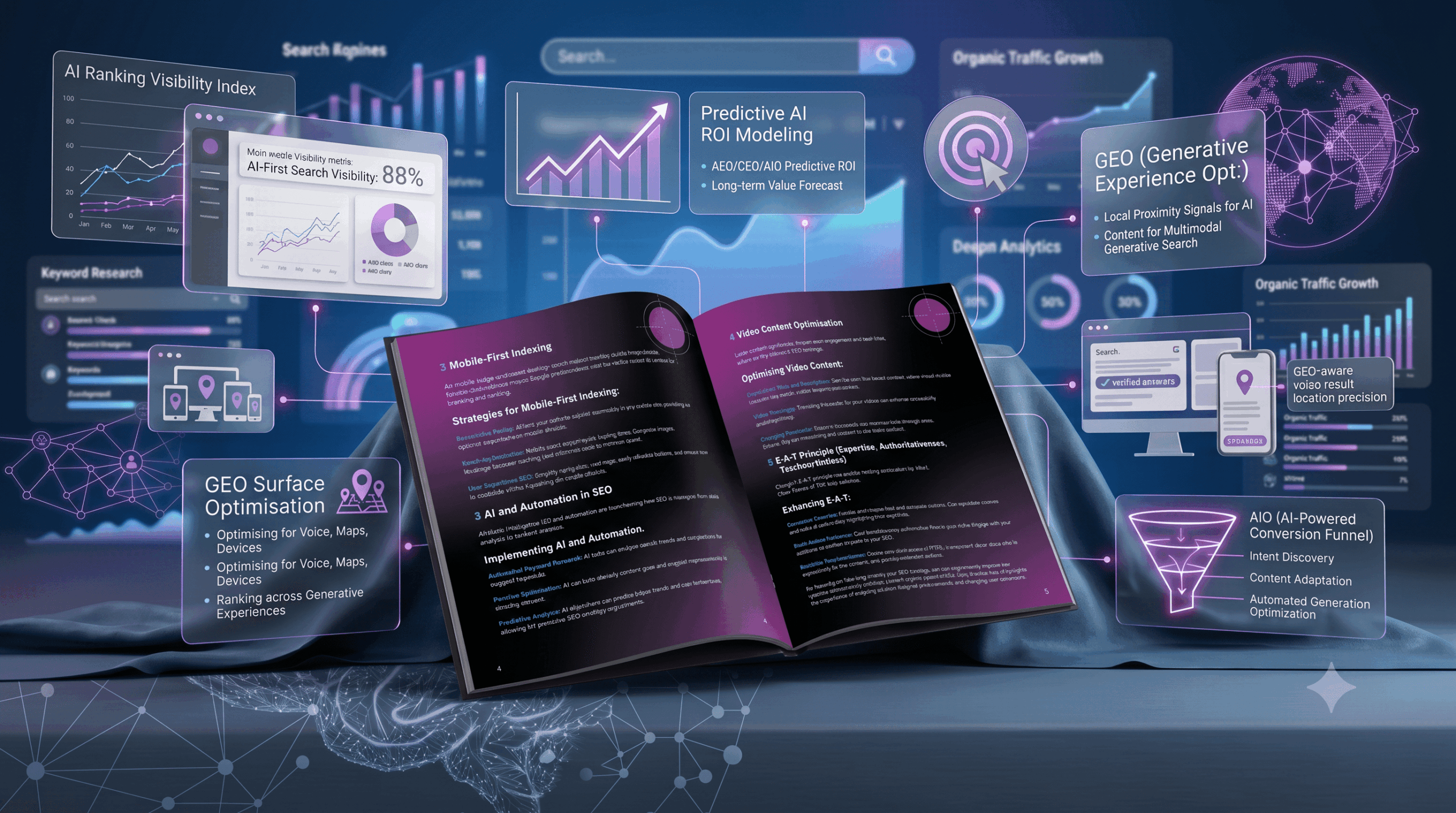
Why AI Optimisation Is Becoming Essential
As AI-generated search experiences continue to grow, businesses must adapt their content and structure accordingly.
This includes focusing on:
- entity optimisation
- structured data and schema
- conversational content formats
- topical authority
- semantic relevance
The goal is no longer simply to rank pages.
It is to become a source AI systems trust enough to reference and recommend.
This represents a major strategic shift.
Modern SEO Is About Influence, Not Just Traffic
Perhaps the biggest change of all is how success is measured.
Traditional SEO focused heavily on traffic volume. Modern digital visibility is increasingly about influence.
A business may now influence buying decisions before a click even occurs. Users may encounter a brand through AI-generated summaries, LinkedIn insights, industry discussions, or educational content long before they visit a website directly.
This means modern SEO must support broader business objectives such as:
- trust-building
- authority positioning
- lead quality
- brand recognition
- conversion efficiency
Traffic still matters — but it is no longer the only metric that matters.
The Businesses Adapting Fastest Will Win
The businesses thriving in modern search environments are not abandoning SEO.
They are evolving it.
They understand that traditional optimisation techniques still have value, but only when combined with broader strategies around authority, user experience, AI visibility, and brand trust.
These businesses are moving beyond rankings and focusing on becoming recognised, credible sources within their industries.
And increasingly, that is what search engines and AI systems reward most.
SEO Is Evolving Into Something Bigger
Traditional SEO is not dead.
But it is no longer enough on its own.
Modern digital visibility now depends on a combination of content quality, semantic clarity, authority, UX, AI-readability, and brand strength. Businesses that continue relying solely on outdated SEO tactics risk losing relevance as search evolves further toward AI-driven discovery.
The future belongs to businesses that understand a fundamental truth:
SEO is no longer just about being found. It is about being trusted, understood, and recommended.
And the businesses that adapt to that reality will be the ones that continue to grow.