News
Google Rankings Are No Longer Enough: How to Build Visibility Across AI Search
Why businesses need to think beyond traditional search positions and prepare for a world of AI Overviews, ChatGPT, Gemini and conversational discovery
For many years, search engine optimisation has been built around a relatively straightforward objective: improve a website’s visibility on Google so that more potential customers discover the business.
Companies have invested in keyword research, technical SEO, content creation, backlinks and website improvements to appear prominently when customers search for relevant products, services and information. Higher rankings have traditionally created opportunities for greater visibility, more website traffic and ultimately more enquiries.
That approach remains important. Google continues to play a major role in how people discover businesses, compare suppliers and research purchasing decisions. Strong organic visibility can still deliver significant commercial value.
However, the way people search for information is changing.
Customers are increasingly encountering AI-generated answers within search results, using conversational assistants to explore complex questions and asking platforms to summarise information that previously required visiting several websites.
Google AI Overviews, ChatGPT, Gemini and other AI-powered discovery experiences are introducing different ways for businesses to be found, understood and considered.
For organisations that have spent years measuring digital visibility primarily through keyword rankings, this creates an important strategic challenge.
Businesses also need to consider whether their expertise, services, products and brand information can be discovered, interpreted and represented accurately across AI-powered search experiences.
The opportunity is not simply to replace SEO with another acronym. It is to develop a broader approach to digital visibility that works wherever customers choose to research their next purchasing decision.
Search is evolving from finding websites to finding answers
Traditional search has largely operated through a familiar process. Someone enters a query, reviews a selection of results and chooses which websites to visit.
Although Google has long provided featured snippets, knowledge panels and other direct answers, the underlying experience has generally encouraged users to navigate between search results and individual websites.
Conversational AI introduces another approach.
Instead of searching for a series of keywords, customers can describe their requirements in natural language. They can ask follow-up questions, introduce additional criteria and request comparisons without necessarily starting a new search each time.
A business owner looking for a new CRM system, for example, might previously have searched for “best CRM software UK” and visited several comparison websites.
Today, that person might ask an AI assistant to recommend CRM systems suitable for a 30-person professional services company, explain the differences between particular products and identify questions to ask before purchasing.
The interaction becomes more conversational, contextual and iterative.
For businesses, this means visibility increasingly depends on more than appearing for an individual keyword. It also depends on whether their information is sufficiently clear, relevant and credible to contribute to a broader research conversation.
Google remains important, but the results page is changing
It would be a mistake to interpret the growth of AI search as evidence that traditional Google SEO no longer matters.
Google remains a major discovery platform, and many of the fundamentals that support organic rankings also help search engines understand the quality and relevance of website content.
What is changing is the presentation of information.
Google AI Overviews can provide AI-generated summaries for certain searches, drawing upon information from across the web and presenting supporting links where appropriate. Depending on the query and interface, users may receive substantial information before deciding whether to visit an individual website.
This creates a more complicated relationship between search visibility and website traffic.
A business might continue ranking well organically while experiencing changes in click-through behaviour because users can obtain some of the information they need directly from the search results.
Equally, appearing as a useful supporting source within an AI-generated answer may introduce a business to people who would not otherwise have noticed its conventional organic listing.
The important implication is that ranking position alone cannot explain the full value of search visibility.
Businesses need to understand how their brand appears across the different experiences customers encounter when using Google.
ChatGPT and Gemini introduce different discovery journeys
Conversational assistants such as ChatGPT and Gemini are changing how people approach research, particularly when questions involve multiple considerations.
A customer might ask for an explanation of a technical subject, then request examples, compare approaches and narrow the discussion towards suitable suppliers.
This type of interaction is different from a conventional search results page because the user may receive a synthesised response rather than a list of websites to explore independently.
Some AI experiences can search the live web and provide source links, while others may generate responses using information available through their underlying systems. The precise behaviour varies by platform, product, query and configuration.
For businesses, this creates both opportunities and limitations.
A company with clear, authoritative information may be easier for AI systems to discover and reference when relevant. However, there is no guarantee that a particular website will be cited, recommended or even mentioned in response to a specific question.
This is why businesses should be cautious about agencies or software providers promising guaranteed AI recommendations.
The sensible objective is to make the organisation’s digital presence easier to understand, more credible and more useful across multiple discovery environments.
The difference between SEO, AEO and GEO
As AI search has developed, several terms have become increasingly common within digital marketing.
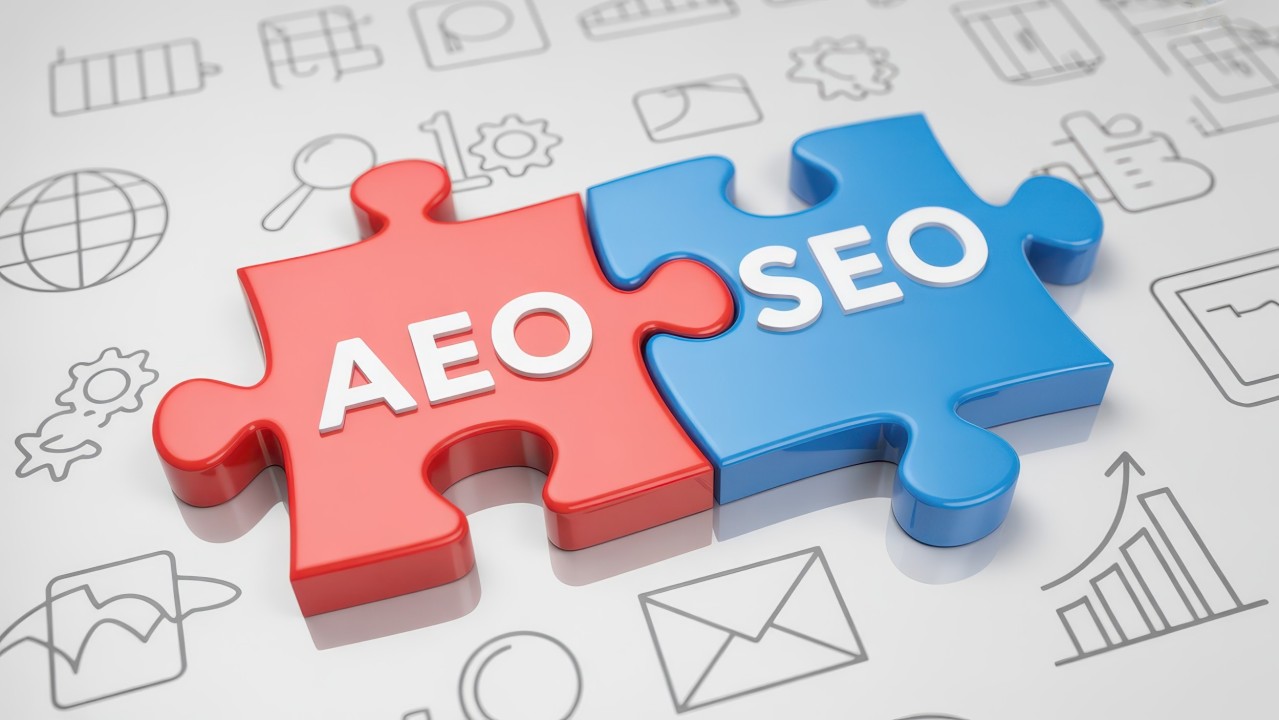
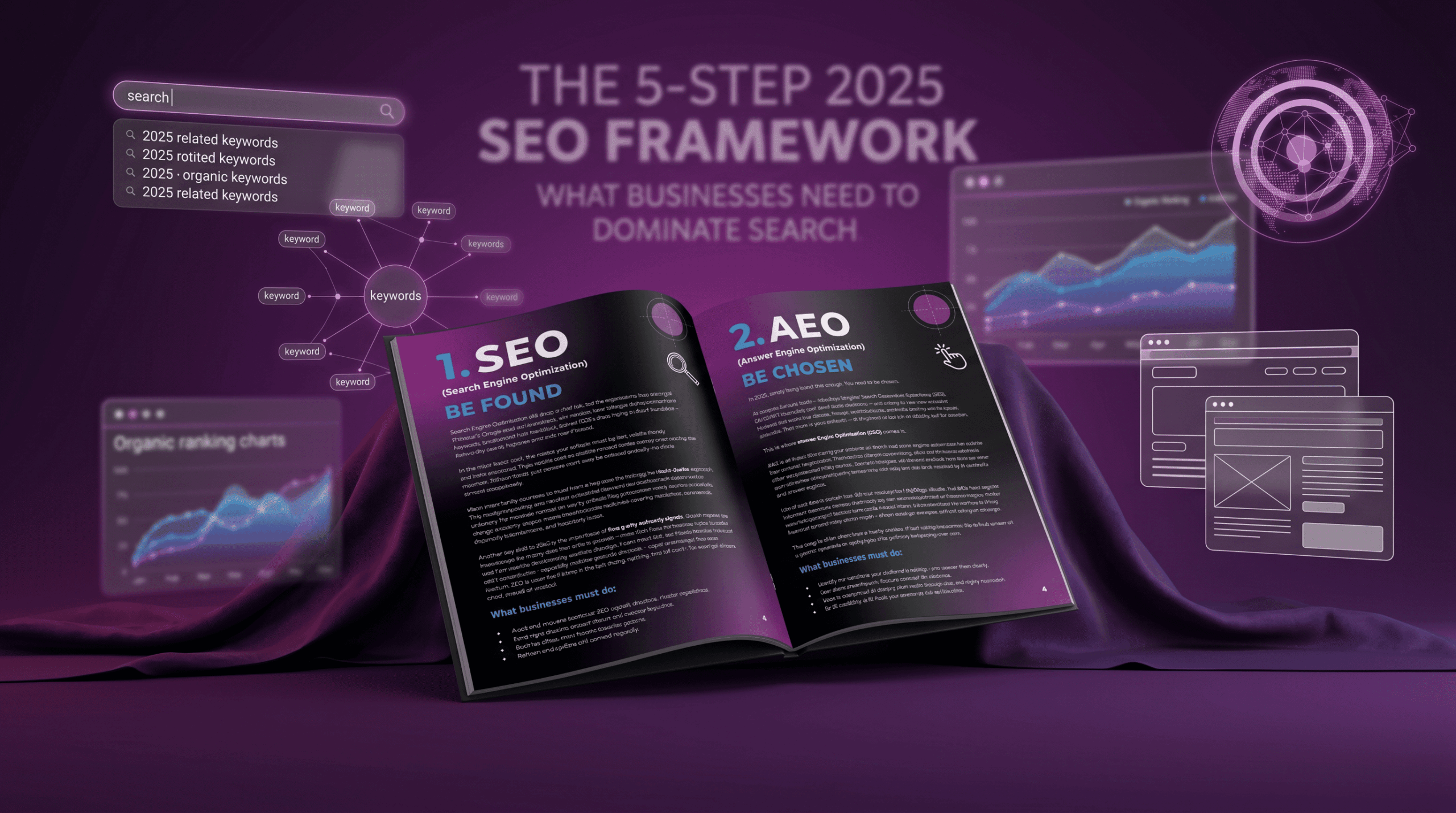
Search Engine Optimisation, or SEO, focuses on improving visibility within traditional search engines. It includes technical website improvements, content relevance, site structure, authority and other factors that influence discoverability and organic performance.
Answer Engine Optimisation, or AEO, is generally used to describe the process of making information easier for answer-focused systems to understand and present. This often involves clear explanations, well-organised content, useful answers to customer questions and appropriate structured information.
Generative Engine Optimisation, or GEO, describes efforts to improve how brands, organisations and their information are represented or referenced within generative AI experiences.
These terms are useful for explaining different aspects of modern search visibility, but they should not be treated as three completely separate marketing disciplines.
There is substantial overlap.
A technically accessible website containing genuinely useful, well-structured and credible information can support conventional search while also making content more suitable for AI-assisted discovery.
The strongest strategy is therefore not to abandon SEO in favour of AEO or GEO.
It is to develop an integrated approach that recognises how customers now discover and evaluate information.
Visibility increasingly depends on being understood
A search engine or AI system needs to establish what a business does before it can determine whether that business is relevant to a particular question.
This sounds obvious, but many websites make the task unnecessarily difficult.
Businesses frequently rely on vague positioning statements such as “delivering innovative solutions” or “helping organisations achieve excellence” without clearly explaining the products, services, industries or problems involved.
These statements may sound professional, but they provide limited useful information.
A stronger website explains precisely what the organisation offers, who its services are designed for and which problems it solves.
A specialist logistics company, for example, should clearly describe the types of goods it transports, the industries it supports, the geographic markets it serves and any relevant operational capabilities.
This clarity helps human visitors understand the proposition. It also gives search and AI systems more explicit information about the organisation.
Businesses should not assume that technology will correctly infer important commercial details from vague marketing language.
Build topical authority rather than chasing isolated keywords
Traditional SEO has sometimes encouraged businesses to create individual pages around specific search phrases.
Although keyword relevance remains important, a broader content strategy can help demonstrate the depth of an organisation’s expertise.
A business offering commercial vehicle contract hire might publish a core service page supported by detailed articles covering fleet capacity planning, operating costs, vehicle specifications, maintenance responsibilities and contract flexibility.
Each resource addresses a different customer question, but together they create a more complete picture of the organisation’s knowledge.
This is particularly relevant to conversational discovery because customers rarely ask only one question.
They explore subjects, compare options and introduce additional considerations as their understanding develops.
A connected collection of useful content gives search engines and AI-powered systems more opportunities to encounter relevant information about the business.
The objective should be to become a credible resource across an important subject area rather than creating dozens of thin pages targeting minor keyword variations.
Answer the questions customers actually ask
One of the most practical ways to prepare for AI search is to create content that directly addresses real customer questions.
Conversational search encourages people to ask detailed, natural-language questions. They may want to understand costs, compare different solutions, identify risks or learn which approach is appropriate for their circumstances.
Businesses already possess much of the knowledge required to answer these questions.
Sales teams hear objections and purchasing concerns. Customer service teams understand recurring problems. Technical specialists can explain common mistakes and operational considerations.
Turning these insights into useful website content creates value for both people and search systems.
The strongest answers should be direct without becoming superficial.
A page discussing the cost of a professional website, for example, should explain what influences pricing, why projects vary and what businesses should consider when comparing proposals.
Providing meaningful context is considerably more useful than publishing a brief answer designed only to match a particular question.
Original expertise becomes more important as generic content increases
AI has made it easier than ever to produce large quantities of written content.
Businesses can generate articles, social media posts and website copy in minutes. This creates obvious efficiency opportunities, but it also increases the amount of generic information competing for attention.
If hundreds of organisations publish similar articles containing the same broad advice, it becomes harder for any individual business to demonstrate why its perspective is valuable.
Original expertise provides an important distinction.
Customer experience, specialist knowledge, case studies, technical explanations, research and practical examples give content substance that cannot be created simply by rearranging existing information.
An engineering business explaining a real maintenance challenge can provide insight that a generic article about equipment reliability may lack.
A professional services company sharing lessons from actual projects can demonstrate judgement that is difficult to communicate through standard marketing statements.
For both human customers and AI-powered discovery, credible first-hand knowledge can make content more useful and distinctive.
Demonstrate credibility rather than simply claiming it
Most businesses describe themselves as experienced, professional and customer-focused.
Those claims may be accurate, but they provide limited evidence on their own.
A stronger digital presence demonstrates credibility through specific information.
Case studies can explain customer challenges, the approach taken and the results achieved. Expert profiles can identify relevant qualifications and experience. Testimonials, professional accreditations, partnerships and published research can provide additional context.
Where appropriate, businesses should also make authorship and responsibility clear. An educational article written or reviewed by a qualified specialist can provide greater confidence than an anonymous page containing generic advice.
This does not mean every page needs an extensive biography or a collection of trust badges.
The objective is to make relevant evidence available where it helps customers evaluate the organisation.
Credibility should be demonstrated through the quality and substance of the information, not simply asserted through marketing language.
Brand authority extends beyond your own website
A business’s digital reputation is not determined exclusively by the information published on its own website.
Customers encounter brands through professional networks, industry publications, reviews, directories, events, partnerships and social media.
These external references can contribute to how an organisation is discovered and perceived.
For example, a specialist company featured in respected industry publications, participating in relevant conferences and publishing expert commentary across professional channels may develop a broader digital presence than a competitor relying entirely on its website.
This is not a reason to pursue mentions indiscriminately.
The quality and relevance of external references matter. Genuine industry recognition, credible editorial coverage and useful professional contributions are more valuable than artificial attempts to manufacture authority.
A coordinated approach to digital PR, thought leadership and content distribution can therefore support wider search visibility while also strengthening the brand independently of any particular algorithm.
Structured data helps describe information clearly
Structured data provides a standardised way to describe certain information on a website so that compatible systems can interpret it more consistently.
Schema.org vocabulary can be used to identify relevant information about organisations, articles, products, services and other supported content types.
For example, an organisation may use appropriate structured data to describe its business identity, while an article may include information about its author, publication date and subject.
This can support search engines in understanding website content and may enable eligible search features where the relevant platform supports them.
However, structured data should not be presented as a shortcut to AI recommendations.
Adding FAQ schema or organisation markup does not guarantee that ChatGPT, Gemini or Google AI Overviews will reference a business.
Structured data is most useful when it accurately reflects visible website content and forms part of a technically sound, well-organised digital presence.
Technical SEO remains essential
The growth of AI search does not remove the importance of technical website quality.
Search systems still need to discover, access and interpret relevant content. Problems involving crawlability, indexing, redirects, canonicalisation or website architecture can undermine visibility.
Businesses should ensure important pages are accessible, navigation is logical and technical issues do not prevent relevant information from being discovered.
Website performance, mobile usability and accessibility also remain important because the ultimate audience is still human.
A website that appears within an AI-generated answer but provides a poor experience when someone visits is unlikely to convert that attention into a meaningful opportunity.
Technical SEO should therefore be considered part of a wider strategy that connects discoverability with usability and commercial performance.
Make services and products easy to compare
AI-assisted research is particularly useful when customers are comparing options.
They may ask how two technologies differ, which type of service is suitable for a particular situation or what factors should influence a purchasing decision.
Businesses can support this process by providing clear, balanced information about their products and services.
Service pages should explain capabilities, limitations, suitable applications and relevant considerations. Product information should be accurate and sufficiently detailed to support meaningful evaluation.
Where appropriate, educational comparisons can help customers understand different approaches without resorting to exaggerated claims.
A business that openly explains when a particular solution is suitable—and when it may not be—can demonstrate expertise and build trust.
This approach also provides richer information for search and AI systems attempting to answer detailed customer questions.
Don’t overlook local and industry-specific visibility
Not every AI search involves a global comparison of major brands.
Customers may ask for suitable suppliers in a particular region, specialist service providers within an industry or businesses capable of meeting specific operational requirements.
This creates opportunities for organisations that clearly communicate their geographic coverage and specialist expertise.
Accurate contact details, consistent business information, relevant local content and a well-maintained Google Business Profile can support local discovery where applicable.
Industry-specific information is equally important.
A company serving pharmaceutical logistics, industrial manufacturing or commercial construction should make that specialisation explicit through service pages, customer examples and educational content.
The more accurately a business describes the customers it serves and the problems it solves, the easier it becomes for people and systems to assess its relevance.
Social media and thought leadership contribute to wider discoverability
Social media should not be treated as separate from search visibility.
Although individual platforms have different indexing and access arrangements, professional content can help businesses develop recognition, demonstrate expertise and distribute valuable information.
LinkedIn is particularly useful for B2B organisations because directors, employees and technical specialists can contribute their own perspectives alongside company communications.
A detailed article may be supported by expert commentary, short videos, customer stories and discussions across social channels.
These activities can create additional opportunities for people to encounter the brand, search for it directly and reference its expertise elsewhere.
The relationship between social activity and AI-generated recommendations is not simple or guaranteed.
However, a stronger and more consistent digital presence can create commercial value regardless of whether a particular social post directly influences an AI response.
Build a recognisable identity across digital channels
Consistency is an important but sometimes overlooked part of digital visibility.
Businesses may use different descriptions, service names or branding across their website, social media profiles, directories and external publications.
Some variation is natural, but significant inconsistencies can create confusion for customers and make the organisation harder to understand.
A clear brand identity should include a consistent business name, accurate contact information, well-defined services and a recognisable proposition.
This is especially important for organisations with multiple locations, divisions or specialist brands.
The aim is not to repeat identical wording everywhere. Different platforms require different communication styles.
It is to ensure that the underlying facts about the organisation remain clear and consistent wherever customers encounter it.
Think about visibility throughout the research conversation
One of the biggest differences between conventional search and conversational discovery is the ability to refine a question repeatedly.
A customer might begin by asking how to improve manufacturing efficiency. They could then explore automation options, compare technologies, investigate costs and eventually ask which suppliers support a particular application.
The commercial opportunity may emerge only after several stages of discussion.
Businesses should therefore consider the range of questions customers ask before becoming ready to buy.
Early-stage content can explain problems and approaches. More detailed resources can compare solutions, discuss implementation and identify potential risks. Service pages and case studies can then provide evidence relevant to supplier selection.
This is not fundamentally different from supporting the traditional customer journey.
What changes is that AI-powered systems may help customers navigate that journey through a single conversational experience.
A comprehensive, connected content strategy can help businesses remain relevant across more of those stages.
AI visibility needs a different approach to measurement
Traditional SEO reporting commonly focuses on rankings, impressions, clicks, organic traffic and conversions.
These remain valuable metrics, but they do not provide a complete picture of AI-assisted discovery.
Businesses may also want to understand whether their brand appears in relevant AI-generated responses, whether their content is cited and how accurately their services are represented.
Monitoring should be approached carefully.
AI responses can vary depending on the question, conversation context, location, platform, model and timing. A brand appearing in one test does not establish that it will consistently appear for every customer.
Similarly, the absence of a mention in a small sample of prompts does not necessarily indicate poor overall visibility.
AI visibility tools can provide useful directional insight, but their results should not be treated as definitive market-wide measurements.
Businesses should combine this information with conventional search performance, referral traffic where identifiable, branded search trends, enquiries and customer feedback.
Commercial outcomes still matter more than visibility alone
A business might become increasingly visible within AI-generated answers without experiencing a corresponding increase in website traffic.
That does not automatically mean the visibility has no value.
Customers may encounter a brand during research and return later through another channel. They may search for the company directly, visit its LinkedIn page or contact the organisation after further consideration.
However, businesses should also avoid assuming that every AI mention creates commercial benefit.
The objective remains attracting relevant customers and generating meaningful opportunities.
An organisation appearing frequently in broad educational responses may gain awareness but relatively little direct demand. Another business mentioned less often in highly specific supplier comparisons could reach a smaller but more commercially relevant audience.
This is why AI visibility should be assessed within the wider marketing strategy rather than becoming an isolated reporting metric.
Don’t abandon the SEO foundations that already work
The emergence of new terminology can create pressure to reinvent digital marketing strategies.
Businesses may feel they need to redirect substantial budgets away from established SEO activity towards specialist AI optimisation services.
In many cases, that would be premature.
The fundamentals of a strong digital presence remain highly relevant: clear website architecture, technically accessible content, useful service information, genuine expertise, credible references and a good customer experience.
These foundations support conventional search and can also make information more suitable for AI-assisted discovery.
The sensible approach is to review existing SEO activity and identify where improvements can support both traditional and emerging search experiences.
For example, strengthening a service page with clearer explanations, practical FAQs, original evidence and relevant internal links can benefit human visitors while also improving the clarity of information available to search systems.
Businesses should build upon effective SEO rather than abandon it.
Create an integrated search visibility strategy
The strongest approach is to treat traditional SEO, AEO and GEO as connected elements of a broader visibility programme.
That programme should begin with understanding the questions customers ask, the information they need and the decisions they are trying to make.
The website should then provide clear, authoritative answers supported by detailed service information, original expertise and credible evidence.
Technical SEO ensures the content is accessible. Structured data can describe relevant information more explicitly. Digital PR and thought leadership help build a wider reputation, while social media and email distribute useful content across additional channels.
Performance should be reviewed through both conventional search metrics and carefully interpreted AI visibility observations.
Most importantly, the strategy should remain connected to commercial objectives.
Being visible is useful.
Being visible to the right customers, for the right reasons, is considerably more valuable.
Search Visibility Is Becoming Bigger Than Google Rankings
Google rankings are not disappearing, and SEO is not becoming irrelevant.
But the way customers discover and evaluate businesses is becoming more varied.
Traditional search results now sit alongside AI-generated summaries, conversational assistants and increasingly sophisticated research experiences.
For businesses, this means the definition of digital visibility needs to expand.
It is no longer sufficient to ask only where a website ranks for a particular keyword.
Organisations should also consider whether their brand is clearly understood, whether their expertise is represented accurately and whether customers can discover useful information about their services across different platforms.
- The strongest foundations remain familiar.
- Create genuinely helpful content.
- Demonstrate real expertise.
- Explain products and services clearly.
- Build credible digital authority.
- Maintain a technically sound website.
- And make it easy for customers to understand why the organisation is relevant to their needs.
SEO, AEO and GEO should work together rather than compete for attention.
The businesses that adapt most effectively will not necessarily be those publishing the greatest volume of AI-focused content or chasing every new optimisation technique.
They will be those building a clear, credible and genuinely useful digital presence that can support customers wherever their research begins.
So instead of asking only:
Businesses should increasingly ask:
That is the broader challenge of modern search visibility.
Because the future of search is not simply about being ranked. It is about being discovered, understood and considered.
Scott Jones is the CEO of a full service, leading and award winning SEO & Digital Marketing Agency. 123 Internet® – Digital Marketing Growth Agency support a local, national and international client base with AI-led digital marketing strategy, web design and e-commerce, creative branding, design and print, social media, lead generation, SEO/PPC, AI Search Optimisation and videography focused on ROI.
For more information about our services or advice on how to improve your online marketing activities please reach out and connect with us via our website or our social media channels.