News
How Long Does SEO Take to Work and What Should Happen During the First 12 Months?
A practical month-by-month guide to technical SEO, content development, digital authority, keyword rankings, organic traffic and lead generation
Search Engine Optimisation is one of the most valuable long-term investments a business can make in its digital presence. When implemented effectively, SEO can help an organisation become more visible to potential customers, attract relevant website visitors and generate enquiries without relying entirely on paid advertising.
However, SEO also creates one of the most common frustrations in digital marketing: understanding how long it should take to deliver results.
Business owners understandably want to know when their investment will begin generating a return. If they are paying an agency every month, they expect to see progress. They want to know when rankings will improve, when website traffic will increase and, most importantly, when more customers will start making enquiries.
The challenge is that SEO does not follow a universal timetable.
A well-established website with strong authority and existing organic visibility may respond relatively quickly to targeted improvements. A new business entering a competitive market may need considerably longer to establish meaningful search visibility.
Technical problems, website history, competition, content quality, available resources and the commercial intent behind targeted searches can all influence the speed of progress.
It is therefore misleading to suggest that every business should expect significant SEO results within three months, six months or any other fixed period.
Nevertheless, businesses should expect a structured programme of activity and measurable progress throughout the first year.
The first 12 months should involve a clear process of research, technical improvement, content development, authority building, performance analysis and continuous optimisation.
Understanding that process makes it much easier to evaluate whether an SEO campaign is moving in the right direction.
Why SEO takes longer than paid advertising
Paid advertising and SEO operate in fundamentally different ways.
With PPC, a business can launch a campaign and begin appearing for relevant searches once the adverts are approved and eligible to run. This does not guarantee profitable results, but it can create visibility almost immediately.
SEO works by improving the relevance, accessibility, usefulness and credibility of a website so that search engines can discover its content and determine when it deserves to appear in organic results.
Those improvements need to be implemented, discovered and evaluated. Search engines must crawl pages, process changes and assess them alongside competing content.
Some technical corrections can produce relatively quick improvements, particularly when they resolve problems that previously prevented important pages from being indexed.
Other activities, such as developing topical authority or building a stronger digital reputation, generally require sustained effort.
This is why SEO should be treated as a long-term commercial investment rather than a campaign expected to produce an immediate and predictable return.
The important distinction is between the time required to complete SEO work and the time required for that work to influence search performance.
What determines how quickly SEO produces results?
Several factors influence the timescale of an SEO campaign.
The first is the website’s starting position. An established organisation with years of relevant content, a strong reputation and existing organic traffic has a different foundation from a new website with limited visibility.
Competition is another important consideration. Ranking for a specialist service within a narrow geographic market may be more achievable than competing nationally for highly commercial searches dominated by established brands.
Website quality also matters. Technical issues, weak service pages, confusing navigation and poor internal linking can restrict performance even when content is being published regularly.
The level of investment influences how quickly improvements can be implemented. A business able to develop substantial educational resources, improve its website and invest in digital PR may progress differently from one with a very limited monthly budget.
Finally, the commercial value of the targeted searches should influence expectations.
A business could achieve rapid traffic growth through broad informational content without generating many enquiries. Another might experience modest traffic increases but attract more relevant customers through improved service-page visibility.
SEO success should therefore be evaluated against the organisation’s commercial objectives rather than simply the speed at which visitor numbers increase.
Month 1: Understanding the website, the market and the opportunity
The first month of an SEO campaign should establish a clear understanding of the business’s current position.
Before making substantial changes, an agency should examine how the website performs technically, which pages are visible in search, what content already exists and where opportunities may be available.
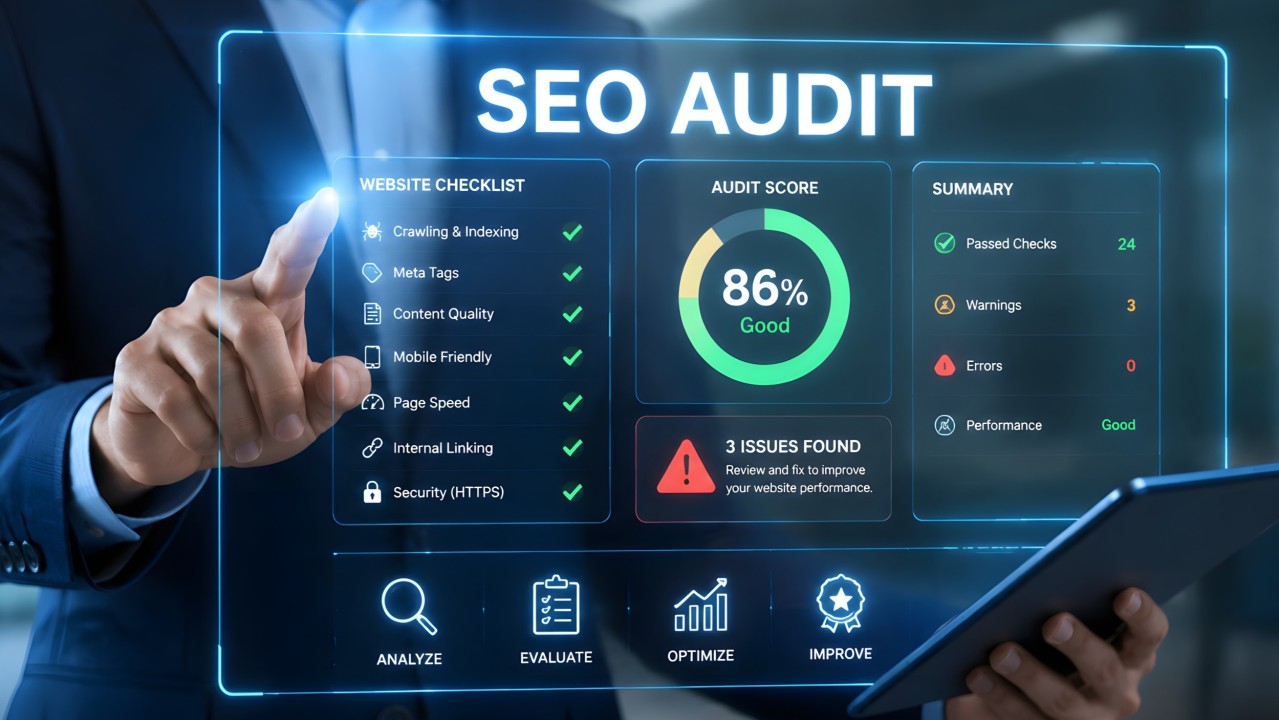
This typically involves a technical SEO audit, keyword and search-intent research, competitor analysis and a review of existing organic performance.
The audit should identify issues affecting crawlability, indexing, website structure, redirects, canonical tags, internal linking, mobile usability and other relevant technical factors.
At the same time, the agency should understand the commercial priorities of the business.
Which services are most important? Which customers generate the greatest value? Which geographic markets matter? What types of enquiries does the organisation want to attract?
Without this context, keyword research can become an exercise in identifying search volume rather than commercial opportunity.
By the end of the first month, the business should have a clearer picture of its starting position, the most important issues and the priorities for improvement.
It should also have an agreed method for measuring progress.
A comprehensive audit is valuable only when its findings lead to an actionable plan.
Month 2: Fixing the foundations and prioritising technical improvements
Once the initial audit is complete, the next priority is usually to address technical problems that could prevent the website from performing effectively.
The precise work will depend on the issues identified.
Some websites may have important pages blocked from indexing. Others may suffer from duplicated content, broken internal links, inefficient redirects or poorly structured navigation.
An agency should prioritise problems according to their likely impact rather than simply attempting to complete the greatest number of technical tasks.
For example, correcting an indexing problem affecting a commercially important service page may be considerably more valuable than making minor adjustments to pages that attract little relevant traffic.
Technical SEO should also consider the experience of human visitors.
Mobile usability, accessibility, page performance and straightforward navigation contribute to a website’s overall effectiveness.
However, businesses should recognise that not every technical improvement produces an immediate ranking increase.
Some changes remove obstacles, making it easier for future content and optimisation to perform.
The objective during this stage is to establish a reliable foundation upon which the wider SEO strategy can develop.
Month 3: Improving existing pages before creating more content
Businesses often associate SEO with publishing new articles, but improving existing website content can be one of the most valuable early activities.
An established service page may already attract impressions and rank for relevant searches without performing particularly well.
Improving its structure, clarity and depth can strengthen its usefulness to customers while helping search engines understand its relevance.
An agency might review page titles, headings, introductory copy, service descriptions, internal links and calls to action.
It should also examine whether the page answers the questions customers commonly ask before making an enquiry.
A commercial service page should explain what is offered, who it is suitable for, which problems it solves and why the organisation is a credible provider.
Where appropriate, relevant case studies, testimonials and supporting information can help strengthen the page.
By the third month, businesses should expect to see meaningful optimisation work being completed, even if ranking improvements are still developing.
Some early movement may become visible through search impressions, indexing improvements or changes in positions for particular queries.
However, these should be treated as indicators of progress rather than guarantees of future results.
Month 4: Developing a content strategy around customer questions
Once the technical foundations and important existing pages have received attention, content development becomes an increasingly important part of the campaign.
The objective should not be to publish articles simply because a monthly content target exists.
Effective SEO content should address subjects that matter to potential customers and support the organisation’s wider commercial priorities.
This might involve practical guides, technical explanations, comparisons, buying advice or answers to common questions.
For example, a commercial vehicle provider could develop content about contract hire, fleet utilisation, vehicle specifications and operating costs.
A digital marketing agency might publish guidance on website performance, lead generation, SEO, AI search and marketing strategy.
The most useful subjects often come from customer conversations.
Sales teams understand the questions asked before purchasing decisions. Technical specialists know the challenges customers face. Account managers can identify recurring concerns.
Turning that expertise into substantial educational resources helps build a connected body of content around the services the business provides.
During this stage, an agency should also consider internal linking so that educational articles naturally guide readers towards relevant service pages and supporting information.
Month 5: Building topical depth and strengthening internal connections
By the fifth month, the focus should increasingly move beyond individual pages towards how the website communicates expertise across important subject areas.
A business may have a strong article about one customer problem, but that article becomes more valuable when it forms part of a broader collection of related resources.
This is often described as building topical authority.
A manufacturer specialising in plastics processing equipment, for example, might develop content about drying, conveying, dosing, temperature control, maintenance and production efficiency.
These subjects are related, but each addresses a different customer need.
Together, they help demonstrate the organisation’s understanding of the wider operational environment.
Internal linking plays an important role by connecting relevant articles, product pages and service information.
The objective is not to create large quantities of content for their own sake.
It is to develop a website that answers important customer questions comprehensively and makes related information easy to discover.
At this stage, businesses may begin seeing a wider range of search queries generating impressions.
However, the value of that visibility depends on whether the content is reaching relevant audiences.
Month 6: Reviewing early performance and adjusting the strategy
Six months is a useful point for conducting a more substantial SEO review.
By this stage, the campaign should have generated enough activity to evaluate what has been implemented and whether early performance is moving in a positive direction.
The review should examine technical improvements, indexing, search visibility, organic traffic, content performance and enquiries.
It should also consider which pages are beginning to gain traction and which areas require further attention.
Some businesses may already be experiencing meaningful increases in organic enquiries. Others may be seeing improvements in impressions and rankings without a significant commercial impact.
Neither outcome should be interpreted without context.
A new website operating in a competitive market may still be establishing its foundations, while an established site benefiting from targeted optimisation could have progressed more quickly.
The agency should explain the results clearly and use them to refine the next phase of work.
If certain topics are attracting relevant visitors, there may be opportunities to develop them further.
If important service pages remain underperforming, the agency should investigate why.
The six-month review should demonstrate that SEO is being actively managed rather than simply repeated.
Month 7: Developing digital authority and external credibility
As the website’s technical foundations and content improve, attention should also be given to how the business is represented beyond its own website.
Search visibility can be influenced by a wider range of authority and reputation signals, including relevant links and credible external references.
Digital PR, industry publications, professional associations, partnerships and genuinely useful thought leadership can help organisations develop a stronger presence.
For example, a specialist engineering company might contribute technical insight to an industry publication.
A professional services organisation could publish original commentary on developments affecting its customers.
A business involved in exhibitions, conferences or industry initiatives may have opportunities to earn relevant coverage and references.
These activities can create value beyond SEO.
They can introduce the brand to new audiences, strengthen credibility and generate referral traffic.
However, businesses should be cautious about link-building approaches focused purely on acquiring large numbers of low-quality links.
A smaller number of relevant, credible references is generally a more sensible objective than pursuing artificial authority through indiscriminate link acquisition.
Month 8: Expanding successful content and improving weaker pages
By the eighth month, an SEO campaign should have a growing body of performance information.
Some articles may be attracting relevant organic traffic. Certain service pages may have improved their positions, while others may still be struggling to gain visibility.
This is an opportunity to move beyond the initial assumptions and make decisions based on evidence.
An agency should review which topics are generating useful engagement, which pages attract commercially relevant searches and where additional improvements could produce value.
A successful educational article might be expanded with more detailed explanations, practical examples or updated information.
A service page receiving impressions but relatively few clicks may benefit from clearer titles and descriptions.
Pages attracting traffic without generating enquiries may need stronger connections to related services or more relevant calls to action.
This stage demonstrates why SEO should involve continuous optimisation rather than an endless programme of publishing new material.
Existing content can often become more valuable when it is reviewed and improved.
Month 9: Connecting organic visibility with lead generation
As SEO activity matures, businesses should increasingly examine the relationship between organic search and commercial performance.
Traffic and rankings remain useful indicators, but they do not explain whether the campaign is attracting valuable opportunities.
An agency should review which landing pages generate enquiries, which search themes appear commercially relevant and how organic visitors move through the website.
This may involve examining conversion rates, enquiry forms, calls, contact-page visits and other meaningful actions.
Where possible, marketing data should also be connected with CRM and sales information.
A business may discover that one service page generates relatively few enquiries but that those enquiries regularly become valuable customers.
Another page might attract substantial traffic but contribute little to the sales pipeline.
These insights can influence future SEO priorities.
The objective is to concentrate effort where organic visibility can contribute most effectively towards business growth.
Month 10: Improving conversion rates and customer experience
Once a website begins attracting more relevant organic visitors, improving the conversion experience can become an increasingly valuable priority.
A business does not always need more traffic to generate more enquiries.
Sometimes it needs to make better use of the visitors it already receives.
Conversion Rate Optimisation may involve improving service-page messaging, strengthening calls to action, simplifying enquiry forms or making supporting evidence easier to find.
The website should provide a clear journey from discovering information to understanding the organisation’s services and taking the next step.
For example, an educational article attracting potential customers could link towards a relevant service page or practical resource.
A service page might benefit from clearer explanations of the process, customer testimonials or a more prominent enquiry option.
Conversion improvements should be evaluated carefully, particularly where website traffic or enquiry volumes are relatively low.
The aim is not simply to increase form submissions.
It is to generate more suitable opportunities from the organic audience.
Month 11: Preparing for changing search behaviour and AI discovery
As the campaign approaches the end of its first year, the strategy should also consider how customers are discovering information beyond conventional organic search results.
Google AI Overviews, ChatGPT, Gemini and other conversational experiences are influencing how people research subjects, compare options and evaluate suppliers.
This does not mean businesses should abandon traditional SEO.
Instead, the website should be reviewed to ensure important information is clear, accurate, well organised and supported by credible expertise.
Educational articles should answer real customer questions, while service pages should explain capabilities and applications without relying on vague marketing statements.
Relevant structured data can help describe certain website information, although it does not guarantee inclusion in AI-generated answers.
Businesses may also begin monitoring how their brand appears in relevant AI-assisted research experiences.
These observations should be treated as directional rather than definitive, because AI-generated responses can vary significantly.
The objective is to strengthen the organisation’s wider digital discoverability while maintaining the SEO foundations already established.
Month 12: Evaluating the first year and planning the next stage
The end of the first year provides an opportunity to evaluate the SEO programme as a whole.
A meaningful annual review should go beyond comparing current keyword rankings with those recorded 12 months earlier.
It should consider the technical condition of the website, improvements to important pages, the development of relevant content and changes in organic visibility.
The review should also examine traffic quality, enquiry generation and commercial outcomes wherever reliable information is available.
Some businesses may have achieved substantial improvements in organic leads. Others may have developed stronger foundations and emerging visibility but still require further investment to compete effectively.
The important question is whether the campaign has created measurable progress relative to the starting position, the available budget and the level of competition.
The agency should also explain what has been learned.
Which services offer the strongest opportunities? Which content themes attract relevant customers? Where does competition remain difficult? What should be prioritised next?
A successful first year should leave the business with a stronger digital asset and a clearer understanding of how future SEO investment can contribute towards growth.
What results should businesses realistically expect after 12 months?
There is no reliable universal percentage increase in rankings, traffic or leads that every business should expect after a year of SEO.
Some organisations experience improvements within weeks when significant technical problems are corrected.
Others begin seeing meaningful commercial results after several months of sustained optimisation.
Highly competitive industries, new websites and businesses entering unfamiliar markets may require a longer investment horizon.
What businesses should reasonably expect is evidence that the agreed work has been completed, that performance is being measured accurately and that the strategy is evolving in response to results.
A useful first-year assessment should distinguish between three types of progress.
The first is delivery: technical issues resolved, pages improved, content published and relevant authority-building work completed.
The second is search performance: improvements in indexing, impressions, rankings and relevant organic traffic.
The third is commercial performance: qualified enquiries, sales opportunities, customer acquisition and revenue influenced by organic search.
These outcomes are connected, but they do not necessarily develop at the same speed.
Understanding the distinction helps businesses evaluate SEO more fairly and avoid unrealistic expectations.
Why rankings alone are not enough
Keyword rankings remain a useful part of SEO reporting, but they should never be the only measure of success.
A business could achieve first-page positions for several low-value searches without generating meaningful commercial enquiries.
Conversely, improving visibility for a highly relevant specialist service could generate valuable opportunities despite relatively modest search volume.
Rankings can also vary by location, device, personalisation and the type of search experience being used.
AI-generated answers and other search features can influence how frequently users click through to websites, even when conventional rankings remain strong.
Businesses should therefore evaluate organic visibility alongside engagement, enquiry quality and wider commercial outcomes.
The objective is not simply to appear higher in Google.
It is to become more discoverable to relevant customers and turn that visibility into business opportunities.
What should your SEO agency be doing every month?
Although the priorities will change throughout the year, businesses should expect ongoing activity rather than a single initial optimisation exercise.
An effective agency should regularly monitor technical performance, review search visibility, identify content opportunities and improve important pages.
It should also analyse competitors, maintain relevant internal links, assess the quality of organic traffic and investigate changes in performance.
Content creation should be guided by customer needs and commercial priorities rather than arbitrary publication targets.
Where appropriate, the agency should support digital authority through credible external references and industry visibility.
Reporting should explain what has been completed, what has changed and what should happen next.
Not every activity needs to occur every month. A substantial technical project may take priority during one period, while another may focus on content development or conversion improvements.
What matters is that the work follows a coherent strategy and contributes towards continuous improvement.
Warning signs that an SEO campaign may not be progressing properly
SEO requires patience, but patience should not be confused with accepting a lack of transparency.
Businesses should be cautious if an agency repeatedly promises significant ranking improvements without explaining the work required.
The same applies when reports focus exclusively on keyword positions without discussing traffic quality, enquiries or the commercial objectives of the campaign.
Another warning sign is a lack of meaningful activity.
If the same technical issues remain unresolved, content is repeatedly published without a clear strategy or recommendations never evolve, it may be appropriate to review the approach.
Agencies should also be able to explain disappointing results.
SEO performance is influenced by factors outside any agency’s direct control, including competition, search engine changes and customer behaviour.
A credible partner should acknowledge those limitations while demonstrating what it is doing to improve the situation.
Businesses should expect informed explanations and realistic recommendations rather than guarantees.
How SEO and PPC can work together during the first year
Businesses do not necessarily need to choose between investing in SEO and generating immediate visibility through paid advertising.
The two approaches can support each other.
PPC may help generate enquiries while organic visibility develops, particularly for new websites or businesses entering competitive markets.
Paid campaigns can also provide insight into which search terms and messages attract relevant customers.
That information can influence SEO content and service-page optimisation.
As organic visibility improves, businesses may have opportunities to review how advertising budgets are allocated.
However, organic rankings do not automatically make PPC unnecessary.
Paid advertising may continue to provide value for competitive searches, product launches or specific commercial opportunities.
The objective should be to coordinate both channels around customer acquisition rather than treating them as competing activities.
Why SEO should continue beyond the first year
A common misconception is that SEO is a project that can be completed once the website reaches a satisfactory position.
In reality, search visibility requires ongoing attention.
Competitors publish new content, websites change, customer questions evolve and search platforms continue developing.
A page that performs well today may become less relevant if its information is not maintained.
New products, services and markets also create additional opportunities for optimisation.
The second year of SEO should therefore build upon the foundations established during the first.
For some businesses, this may involve expanding into new subject areas or geographic markets.
Others may focus on improving conversion rates, strengthening digital authority or developing more advanced content.
The long-term advantage comes from continuously improving an increasingly valuable digital asset rather than repeatedly starting from the beginning.
SEO Takes Time, but Progress Should Be Visible
SEO is not an overnight solution, and no credible agency should guarantee that every business will achieve significant rankings, traffic or lead growth within a fixed period.
However, businesses should not interpret this uncertainty as a reason to accept twelve months of activity without understanding what is happening.
The first year should follow a structured process.
Technical foundations need to be reviewed and improved.
Important service pages should become clearer and more relevant.
Educational content should address genuine customer questions.
Digital authority should develop through credible expertise and external recognition.
Performance should be monitored, and the strategy should evolve as evidence becomes available.
Over time, the focus should increasingly move from completing SEO tasks towards improving relevant visibility, attracting qualified visitors and generating meaningful commercial opportunities.
The most useful question is therefore not simply:
It is:
A strong SEO strategy should be able to answer those questions.
Because successful SEO is not about waiting for rankings to improve.
It is about consistently building a stronger, more discoverable and more commercially effective digital presence.
Scott Jones is the CEO of a full service, leading and award winning SEO & Digital Marketing Agency. 123 Internet® – Digital Marketing Growth Agency support a local, national and international client base with AI-led digital marketing strategy, web design and e-commerce, creative branding, design and print, social media, lead generation, SEO/PPC, AI Search Optimisation and videography focused on ROI.
For more information about our services or advice on how to improve your online marketing activities please reach out and connect with us via our website or our social media channels.