News
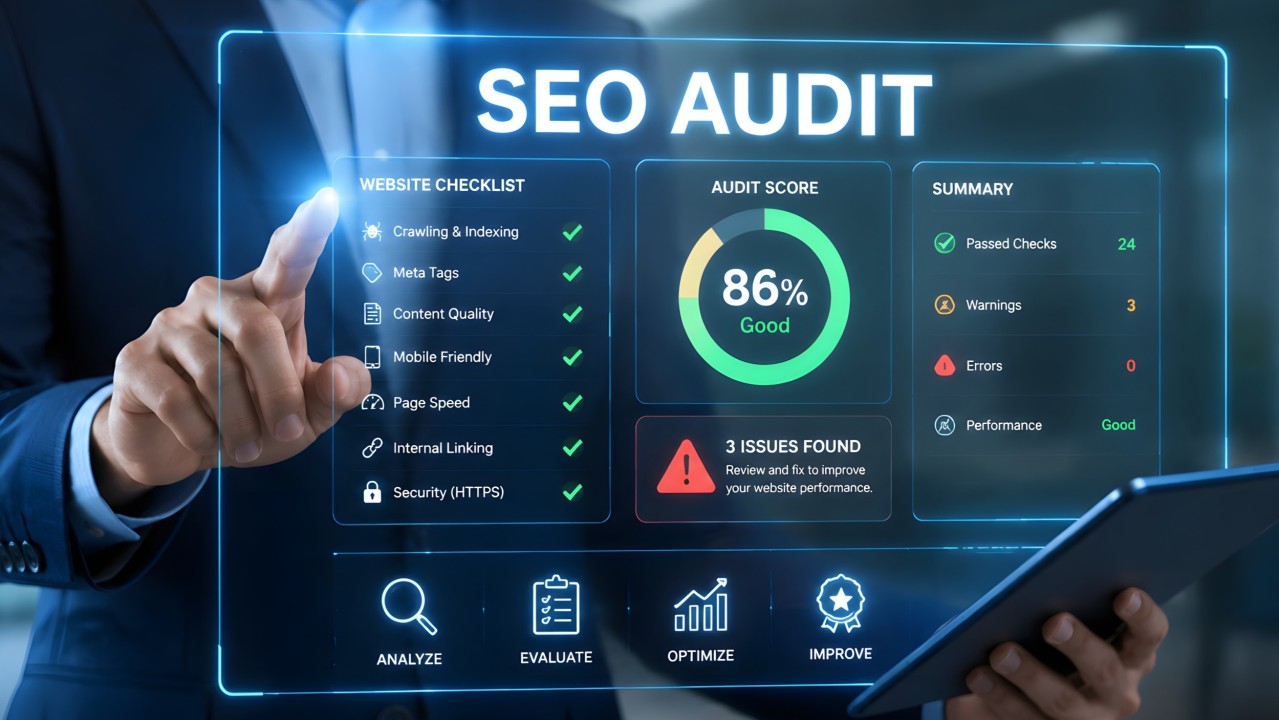
SEO Audit Guide: 20 Things Businesses Should Check on Their Website
A practical guide to identifying technical SEO problems, improving search visibility, strengthening content and turning more website visitors into customers
A business website can look professional, contain useful information and receive regular updates, yet still struggle to attract relevant visitors through search engines.
Sometimes the problem is technical. Important pages may not be indexed correctly, website performance could be poor or search engines may struggle to understand the site’s structure.
In other cases, the challenge is content. Service pages might lack detail, articles may not answer the questions customers are asking or competitors may provide more useful information.
There is also a third consideration that businesses frequently overlook: commercial performance.
A website can rank well on Google and generate substantial traffic without producing enough genuine enquiries. If visitors cannot understand the organisation’s services, find evidence of its expertise or take the next step easily, improved search visibility may deliver limited business value.
This is why conducting a regular SEO audit is so important.
An effective audit does more than identify technical errors or generate a list of recommendations from automated software. It examines how effectively a website can be discovered, understood, trusted and used by potential customers.
It should also consider how search behaviour is evolving. Traditional Google rankings remain important, but AI Overviews, ChatGPT, Gemini and other conversational discovery experiences are changing how customers research products and services.
The following 20 checks offer a practical starting point for businesses wanting to understand where their website may be underperforming and which improvements could deliver the greatest value.
1. Check whether Google is indexing your important pages
Before worrying about keyword rankings, businesses need to establish whether their important website pages are actually appearing in Google’s index.
Indexing is the process through which search engines process discovered pages and determine whether they should be included in search results. If a page is not indexed, it cannot appear as a conventional organic Google result.
Google Search Console provides information about indexing status and can help identify pages that have been excluded or encountered problems. Businesses should review their main service pages, product categories, important articles and other commercially relevant content.
Not every page needs to be indexed. Thank-you pages, certain filtered URLs and duplicated content may have legitimate reasons for exclusion.
The concern arises when valuable pages are missing unexpectedly.
If an important service page is not indexed, investigate whether it is accessible, contains appropriate directives, has a suitable canonical URL and provides sufficiently useful content.
Resolving indexing problems can be one of the most important early steps in improving SEO performance.
2. Review your robots.txt file and indexing directives
A website’s robots.txt file provides instructions about which areas compliant search crawlers may access.
This can be useful for managing crawling, but incorrect configurations may prevent search engines from accessing important sections of a website.
Businesses should review whether their robots.txt file contains restrictions that unintentionally affect service pages, product information or other valuable content.
They should also examine page-level robots directives, including noindex instructions that tell supporting search engines not to include particular pages in their indexes.
These settings are especially important after website redesigns, migrations or development projects.
A staging website may correctly prevent indexing during development, but problems can occur if those restrictions remain active after launch.
It is also important to understand that robots.txt and noindex perform different functions. Blocking crawling does not necessarily guarantee that a URL will disappear from search results.
An SEO audit should confirm that the website’s technical instructions reflect its intended search visibility.
3. Make sure your XML sitemap is accurate
An XML sitemap helps search engines discover important URLs on a website.
For many websites, content management systems and SEO plugins generate these files automatically. However, automatic generation does not guarantee that the sitemap is accurate or useful.
Businesses should check that their sitemap contains the canonical URLs of important, indexable pages.
It should not routinely include deleted pages, redirects, URLs marked noindex or large numbers of unnecessary duplicates.
The sitemap should also be accessible and, where appropriate, submitted through Google Search Console.
For larger websites, separate sitemaps for different content types can make monitoring easier.
A sitemap does not guarantee indexing or rankings, but it provides a useful discovery mechanism and can help identify inconsistencies in the website’s structure.
4. Identify broken links, redirects and missing pages
Broken links create frustration for visitors and can prevent search engines from reaching useful content.
A website may accumulate broken URLs over time as services change, articles are removed, products are discontinued or page addresses are updated.
An SEO audit should identify internal links pointing towards missing pages, unnecessary redirect chains and important URLs returning errors.
Where content has moved permanently, appropriate redirects can help visitors and search engines reach the replacement page.
However, businesses should avoid redirecting every deleted page to the homepage regardless of relevance.
The destination should make sense for the original content and the user’s expectations.
It is also worth reviewing external links within educational articles and resources, particularly where referenced information may have changed.
Maintaining accurate links improves navigation, reduces unnecessary friction and supports a healthier website structure.
5. Check canonical URLs and duplicate content
Duplicate or substantially similar content can appear for several reasons.
E-commerce websites may generate multiple URLs for the same product through filtering or sorting. Content management systems can create alternative page addresses, while tracking parameters may produce additional URL variations.
Canonical tags help indicate which version of a page should be treated as the preferred URL.
Businesses should check that important pages reference appropriate canonical addresses and that these signals are consistent with internal links, redirects and sitemap entries.
Incorrect canonical tags can create significant problems.
For example, a valuable service page might unintentionally identify another URL as its preferred version, making it harder for search engines to interpret the intended page.
Duplicate content does not automatically result in a penalty, but unnecessary duplication can create confusion and reduce the efficiency of crawling and indexing.
The objective is to establish a clear, consistent version of each important resource.
6. Test website speed and Core Web Vitals
Website performance influences how visitors experience a business online.
Slow-loading pages can create frustration, particularly for mobile users, and may reduce the likelihood that someone explores further or submits an enquiry.
Google’s Core Web Vitals provide useful measurements relating to loading performance, responsiveness and visual stability.
These include Largest Contentful Paint, Interaction to Next Paint and Cumulative Layout Shift.
Businesses can use tools such as PageSpeed Insights and Google Search Console to identify potential performance issues.
Common problems include oversized images, unnecessary scripts, poorly configured caching and excessive third-party resources.
However, an audit should avoid treating a perfect performance score as the ultimate objective.
The priority is delivering a fast, stable and usable website while considering the commercial value and practical cost of proposed improvements.
7. Review mobile usability and accessibility
For many businesses, a substantial proportion of website visits now take place on mobile devices.
A website that looks excellent on a desktop computer may still create difficulties on smaller screens.
Businesses should test important pages using actual mobile devices rather than relying entirely on automated tools.
Navigation should be straightforward, text should remain readable and buttons should be easy to select.
Forms, menus, product options and interactive elements should work reliably without unnecessary zooming or horizontal scrolling.
Accessibility is another important consideration.
Clear headings, appropriate colour contrast, keyboard accessibility, meaningful image alternatives and understandable form labels can improve usability for a wider range of visitors.
An accessible website is not automatically guaranteed better rankings, but improving accessibility can strengthen the customer experience and remove unnecessary barriers to engagement.
8. Examine website navigation and information architecture
A website’s structure influences how easily visitors and search engines can find relevant information.
Important services should not be buried beneath confusing menus or disconnected from related content.
An SEO audit should review whether the navigation reflects how customers think about the organisation’s products and services.
For example, a business offering several specialist solutions may benefit from clearly defined service categories supported by relevant subpages.
Educational articles should connect naturally with the services they discuss.
The objective is to create a logical hierarchy that makes important information accessible without forcing visitors through unnecessary steps.
Businesses should also review whether multiple pages compete to explain the same service or whether valuable subjects are missing entirely.
Good information architecture supports SEO, but it also helps customers understand the organisation more quickly.
9. Audit page titles and meta descriptions
Page titles remain an important way to communicate the subject of a webpage to search engines and potential visitors.
Businesses should review whether important pages have unique, descriptive titles that accurately reflect their content.
A service page titled simply “Our Services” provides considerably less context than one identifying the specific service and relevant business proposition.
Titles should be written for clarity rather than filled with repeated keywords.
Meta descriptions can also help explain what users will find when they visit a page, although search engines may generate alternative snippets depending on the query.
An effective description should communicate the page’s relevance and provide a genuine reason to click.
Businesses should also check for missing, duplicated or misleading metadata across important URLs.
The objective is not simply to improve how a listing looks.
It is to help attract visitors whose needs match the information available on the page.
10. Review headings and content structure
Headings help visitors navigate information and understand how different sections relate to one another.
They also provide useful context for search engines interpreting page content.
An SEO audit should examine whether important pages have clear, descriptive headings arranged in a logical hierarchy.
The main heading should communicate the subject of the page, while supporting headings should introduce meaningful sections.
Businesses should avoid using headings purely for visual styling or inserting keywords unnaturally into every section.
The content itself should also be easy to read.
Long, uninterrupted blocks of text can make information difficult to navigate, particularly on mobile devices.
A well-structured page uses clear explanations, sensible paragraphs and relevant headings to make complex subjects easier to understand.
These improvements support human visitors and can also make information easier for automated systems to interpret.
11. Assess whether service pages answer customer questions
Service pages are often among the most commercially important parts of a business website.
Yet many contain surprisingly little useful information.
A short paragraph explaining that the organisation provides a particular service may not give customers enough detail to decide whether it meets their requirements.
An SEO audit should examine whether each important service page clearly explains what is offered, who it is suitable for and which problems it solves.
It should also consider the questions customers typically ask before making an enquiry.
These might involve processes, timescales, suitability, technical requirements, costs or the differences between available options.
The objective is not to make every service page unnecessarily long.
It is to provide enough relevant information for customers to understand the proposition and evaluate the organisation with confidence.
Strong service pages can support both search visibility and conversion performance.
12. Identify thin, outdated or overlapping content
Publishing more content does not automatically improve SEO.
A website containing hundreds of short, repetitive or outdated articles may provide less value than one with a smaller collection of genuinely useful resources.
Businesses should review existing content to identify pages that no longer reflect current services, contain inaccurate information or provide limited value.
They should also look for unnecessary overlap.
Several articles addressing almost identical questions may compete for similar searches without offering meaningfully different information.
In some circumstances, combining related content into a stronger resource may be more effective than maintaining multiple weak pages.
Other pages may benefit from updating, expanding or redirecting.
However, businesses should not automatically delete content simply because it receives little traffic.
Some specialist pages serve important customers despite attracting relatively few visitors.
Content decisions should consider relevance, usefulness and commercial purpose alongside performance data.
13. Check keyword targeting and search intent
Keyword research remains important, but an effective SEO audit should go beyond identifying which phrases have the highest search volumes.
The key consideration is search intent.
Someone searching for a general explanation of a subject may have very different requirements from someone actively comparing suppliers.
Businesses should examine whether their pages match the intentions behind the searches they are targeting.
Educational articles are often suitable for informational questions, while detailed service pages are generally more appropriate for commercially focused searches.
An audit should also identify important subjects for which the website has little or no relevant content.
This can reveal opportunities to develop new service pages, buying guides or educational resources.
The aim is to attract visitors who are genuinely relevant to the organisation.
A smaller number of commercially valuable searches may contribute more towards business growth than substantial traffic from broad, unrelated topics.
14. Improve internal linking between related pages
Internal links help visitors move between relevant information and allow search engines to discover relationships between pages.
However, internal linking is frequently overlooked when businesses publish new content.
An educational article may attract relevant visitors but provide no clear route towards the organisation’s services.
Similarly, an important service page may lack links to useful case studies, technical guidance or supporting resources.
An SEO audit should identify opportunities to connect related content naturally.
For example, an article explaining the financial impact of equipment downtime could link towards maintenance services, relevant products or a detailed customer case study.
The link should make sense within the surrounding content.
Businesses should avoid inserting large numbers of unrelated links simply to increase internal linking volume.
A thoughtful structure improves navigation, supports topical relationships and helps visitors continue their journey.
15. Evaluate expertise, credibility and trust signals
Customers need confidence before choosing a supplier, particularly when purchasing decisions involve significant budgets, technical requirements or operational risks.
A website should provide evidence that the organisation understands its industry and can deliver what it promises.
An SEO audit should review whether relevant pages include credible information about the business’s experience, people, qualifications and capabilities.
Case studies, customer testimonials, accreditations, professional memberships and examples of completed work can all contribute towards trust.
Educational content should also demonstrate genuine knowledge.
Where appropriate, articles can identify their authors or contributors and explain the expertise behind the information.
This does not mean adding generic trust badges to every page.
The objective is to provide relevant evidence where it helps customers assess the organisation.
Credibility supports commercial decision-making and contributes to the overall quality of the digital presence.
16. Review backlinks and wider digital authority
A business’s search visibility is influenced partly by how its website is referenced elsewhere online.
Relevant links from credible websites can help search engines discover content and provide signals about its reputation.
An SEO audit should examine the website’s backlink profile, including the relevance and quality of referring websites.
Businesses should look for legitimate opportunities to strengthen authority through industry publications, partnerships, professional associations, events and digital PR.
However, the objective should not be to acquire as many links as possible.
Low-quality link schemes, irrelevant placements and artificial authority-building tactics can create unnecessary risks.
The audit should also consider the wider digital reputation of the organisation.
Industry recognition, expert commentary and credible third-party references can contribute towards brand visibility beyond conventional search rankings.
A sustainable authority strategy is built through genuine relevance and expertise rather than shortcuts.
17. Check local SEO and business information
For organisations serving specific geographic markets, local visibility can be particularly important.
An SEO audit should review whether the website clearly communicates relevant service areas, locations and contact information.
Businesses with eligible local operations should also examine their Google Business Profile.
Important details include the business name, address where applicable, telephone number, website link, business categories and other relevant profile information.
Consistency across credible directories and business listings can help reduce confusion.
Customer reviews may also contribute towards how potential buyers evaluate local suppliers.
However, businesses should avoid creating unnecessary location pages containing near-identical content for every town or city.
Location-focused information should be genuinely useful and accurately reflect where the organisation operates.
The objective is to help relevant customers understand whether the business can serve their needs.
18. Review structured data and AI search readiness
Search visibility is increasingly influenced by experiences beyond conventional lists of organic results.
Google AI Overviews, ChatGPT, Gemini and other conversational systems are changing how people research products, services and suppliers.
An SEO audit should therefore consider whether the website presents information clearly enough for both human visitors and automated systems to interpret.
Relevant structured data can help describe certain types of information using recognised formats such as Schema.org.
This might include organisation details, articles, products or other supported content types.
However, structured data does not guarantee rankings, rich results or inclusion in AI-generated answers.
Businesses should also examine the quality of their content.
Are services explained clearly? Does the website answer genuine customer questions? Is important information accurate and consistent? Are claims supported by credible evidence?
These fundamentals remain valuable across traditional SEO, Answer Engine Optimisation and Generative Engine Optimisation.
19. Check conversion paths, calls to action and enquiry forms
Search visibility only creates commercial value when it contributes towards meaningful business outcomes.
A website may attract relevant visitors but lose opportunities because the next step is unclear or unnecessarily complicated.
An SEO audit should therefore examine the customer journey.
Can visitors easily identify the organisation’s services? Are calls to action relevant to the information being viewed? Is contact information straightforward to find?
Enquiry forms should be tested across devices to ensure they work reliably.
Businesses should also consider whether forms request an appropriate amount of information.
Too many fields may discourage submissions, while too little qualification can result in unsuitable enquiries.
Supporting evidence such as testimonials, case studies and clear process explanations can help reduce uncertainty.
Conversion optimisation should be treated as an essential part of SEO because attracting more visitors is only valuable when the website can make effective use of that attention.
20. Audit analytics, reporting and commercial performance
The final check is arguably one of the most important.
Businesses need reliable information about whether their website is attracting the right audience and contributing towards commercial objectives.
An SEO audit should review analytics configuration, Google Search Console data and relevant conversion tracking.
Important actions might include enquiry form submissions, telephone calls, quotation requests, bookings or online purchases.
Where practical, this information should connect with CRM and sales data so that the business can distinguish between enquiries and genuinely valuable opportunities.
The audit should also consider whether reports focus too heavily on rankings and traffic without explaining commercial performance.
A website generating substantial organic traffic may still require improvement if that traffic rarely produces qualified enquiries.
The objective is to establish a clear connection between search visibility, customer behaviour and business results.
Reliable measurement makes it easier to prioritise future SEO investment.
How often should businesses conduct an SEO audit?
There is no universal schedule that suits every website.
A comprehensive audit is particularly valuable when beginning an SEO programme, preparing for a website redesign or investigating significant performance problems.
Businesses should also conduct periodic reviews as their websites grow and change.
Technical monitoring may need to happen frequently, particularly for large e-commerce websites or platforms where products and pages change regularly.
Content reviews, internal linking assessments and conversion analysis can form part of an ongoing optimisation programme.
For many smaller B2B websites, a structured review every few months alongside continuous monitoring can provide a practical approach.
The important principle is that an SEO audit should not be treated as a one-off document.
Its findings should lead to prioritised improvements, with progress reviewed over time.
How should businesses prioritise SEO audit findings?
One of the biggest challenges with SEO audits is deciding what to do with the results.
Automated tools can identify hundreds or even thousands of potential issues.
However, not every warning has the same significance.
A missing meta description on a low-priority page may be considerably less important than an indexing problem affecting a valuable service.
Similarly, improving an article that already attracts relevant visitors may generate more commercial value than correcting minor technical warnings across pages with little business relevance.
A useful approach is to assess findings according to their likely impact, urgency, effort and commercial importance.
Critical issues affecting accessibility, indexing or important conversion journeys should generally receive early attention.
Content improvements and authority-building activities can then be planned around the organisation’s wider objectives.
The aim is not to achieve a perfect score in an SEO audit tool.
It is to identify the improvements most likely to make the website more discoverable, useful and commercially effective.
Why an automated SEO audit is not enough
Automated auditing tools are extremely useful for identifying technical problems and monitoring website performance.
They can detect broken links, missing metadata, indexing inconsistencies and numerous other issues that would be difficult to identify manually.
However, software cannot fully understand the commercial context of a business.
It may identify a page with limited traffic without recognising that the page supports a highly valuable specialist service.
It may recommend increasing content length without understanding whether additional information would genuinely help customers.
It may also assign a high severity rating to an issue that has relatively little practical impact.
A meaningful SEO audit therefore requires human interpretation.
Technical findings should be considered alongside customer needs, competitor activity, content quality and commercial objectives.
The most useful outcome is not simply a list of errors.
It is a clear explanation of what should be improved, why it matters and which actions should be prioritised.
SEO audits should support continuous improvement
A website is never permanently optimised.
Businesses introduce new services, publish articles, change website designs and update their technology.
Competitors improve their digital presence, search behaviour evolves and customers develop new expectations.
These changes create opportunities as well as potential problems.
A regular SEO audit helps organisations identify where their website may be falling behind and where further investment could produce value.
It also provides an opportunity to review whether previous improvements have delivered the expected results.
For example, technical corrections may improve indexing, while content changes could increase visibility for relevant searches.
Conversion improvements may generate more enquiries without requiring additional traffic.
Each review should contribute towards a clearer understanding of how the website supports the business.
A Good SEO Audit Should Lead to Better Business Results
An effective SEO audit is not simply about identifying technical errors or improving keyword rankings.
It is about understanding how well a website performs as a digital business asset.
Technical SEO ensures that important information can be discovered and interpreted.
Content quality helps customers find useful answers and understand the organisation’s expertise.
Internal linking and website structure make information easier to navigate.
Digital authority supports credibility, while conversion optimisation helps turn relevant visitors into genuine opportunities.
Analytics then provides the evidence needed to understand what is working and what should improve.
The 20 checks outlined in this guide provide a practical starting point for evaluating these different areas.
However, businesses should remember that the objective is not to complete every possible SEO task.
It is to prioritise the improvements that will make the greatest difference.
So instead of asking only:
Ask:
That question creates a much more useful starting point.
Because the real purpose of an SEO audit is not to produce a report.
It is to create a clear, practical roadmap towards stronger search visibility, a better customer experience and more meaningful business growth.
Scott Jones is the CEO of a full service, leading and award winning SEO & Digital Marketing Agency. 123 Internet® – Digital Marketing Growth Agency support a local, national and international client base with AI-led digital marketing strategy, web design and e-commerce, creative branding, design and print, social media, lead generation, SEO/PPC, AI Search Optimisation and videography focused on ROI.
For more information about our services or advice on how to improve your online marketing activities please reach out and connect with us via our website or our social media channels.