News
What Is Local SEO and How Can It Help Customers Find Your Business?
A practical guide to improving local search visibility, attracting nearby customers and turning Google searches into genuine business opportunities
When someone needs an accountant, solicitor, restaurant, electrician, marketing agency, engineering supplier or almost any other product or service within a particular area, one of the first things they are likely to do is search online. They might search for “accountant near me”, “web design agency Milton Keynes”, “commercial electrician Buckinghamshire” or simply ask their phone or an AI assistant to recommend a suitable local business.
These searches are commercially important because they often demonstrate strong intent. The person is not necessarily browsing for general information. They may have already identified what they need and are now trying to decide which business to contact, visit or purchase from. Appearing prominently at that point can place an organisation directly in front of a potential customer at precisely the moment they are considering their options.
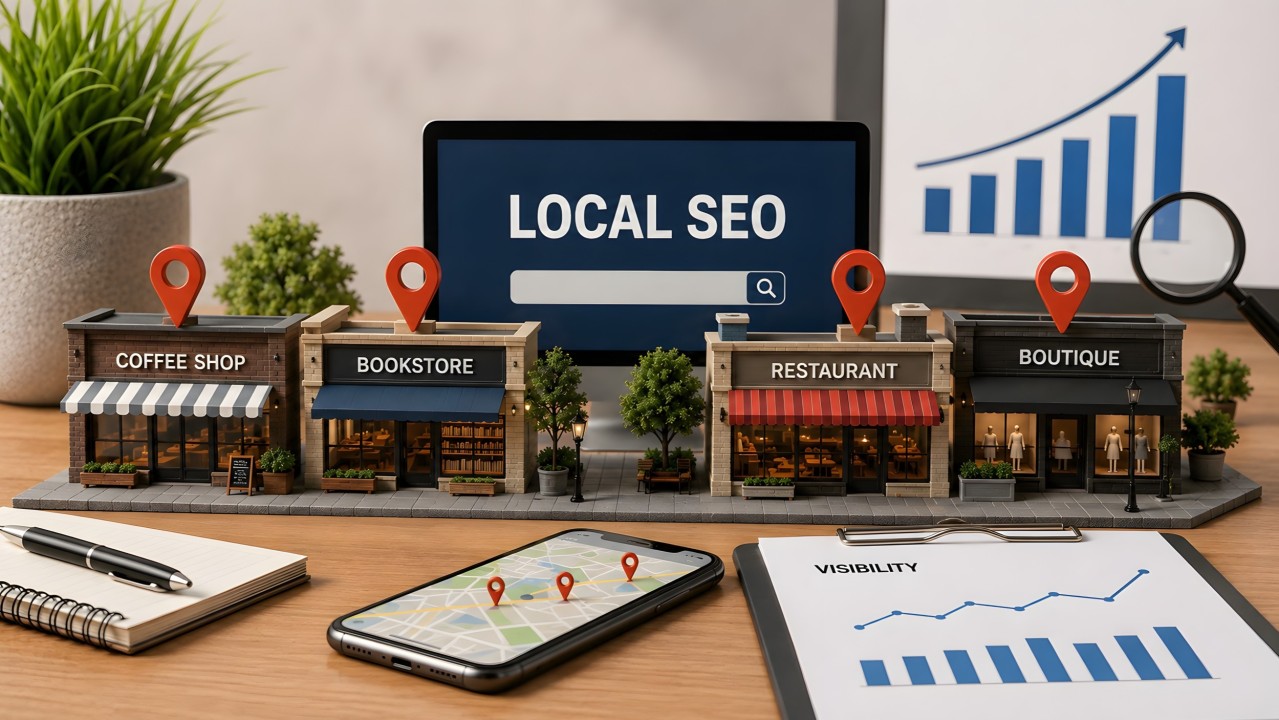
This is where Local Search Engine Optimisation, usually shortened to Local SEO, becomes important. Local SEO is the process of improving a business’s visibility for searches where location influences the results. It combines elements of traditional SEO with business information, reviews, location relevance, website content and wider signals that help search engines understand where an organisation operates and which local customers it is relevant to.
For businesses serving specific towns, cities, counties or regions across the UK, Local SEO can become one of the most valuable parts of a digital marketing strategy. It can help increase visibility on Google, improve discovery through map-based results, strengthen trust and ultimately generate more telephone calls, website visits, enquiries and physical visits.
However, successful Local SEO involves considerably more than repeatedly adding the name of a town to website pages. It requires creating a clear and credible digital presence that demonstrates what the business does, where it operates and why customers within those locations should consider it.
What is Local SEO?
Traditional SEO focuses broadly on improving a website’s visibility within organic search results. Local SEO shares many of the same principles but places greater emphasis on searches where geographic relevance matters.
Consider the difference between someone searching for “how does commercial property law work?” and someone searching for “commercial property solicitor in Birmingham”. The first search is primarily informational, while the second contains an obvious location and potentially much stronger commercial intent. Search engines need to identify not only which businesses are relevant to commercial property law but also which organisations genuinely serve customers in or around Birmingham.
Location does not always need to be typed explicitly. Searches containing phrases such as “near me”, “nearby” or “closest” clearly communicate local intent, but search engines can also recognise when the nature of a query is likely to require a local result. Someone searching simply for “Italian restaurant” or “emergency plumber”, for example, is unlikely to want suggestions hundreds of miles away.
Local SEO therefore helps search engines connect relevant businesses with geographically appropriate searches. This involves information contained on the website as well as external signals such as business profiles, reviews, citations and references elsewhere online.
Why Local SEO matters for UK businesses
For businesses that depend upon customers within a defined geographic area, search visibility can have a direct commercial impact. A potential customer may be choosing between several nearby suppliers and could make that decision within minutes of starting their research.
If your business does not appear during that research, it may never enter the consideration process.
This is important for obvious location-dependent organisations such as restaurants, shops, dentists, estate agents and tradespeople, but Local SEO extends far beyond traditional high-street businesses. Accountants, solicitors, consultants, manufacturers, commercial contractors, technology providers and B2B service organisations can also benefit where geography plays a role in customer decisions.
A company may technically serve customers throughout the UK while still having particularly strong opportunities within certain regions. Local SEO can help build visibility in those priority areas without requiring the business to pretend it has offices or locations that do not genuinely exist.
The underlying principle is simple: if location influences who your customers choose, location should form part of your search strategy.
Local SEO is about more than ranking number one
Businesses sometimes reduce SEO success to a single objective: ranking first for a particular keyword. While strong rankings can obviously be valuable, Local SEO should be viewed more broadly.
The real objective is increasing the likelihood that a relevant local customer discovers, trusts and contacts the business.
A customer might first encounter the organisation within map results, then read reviews, visit the website, examine services, look at case studies and eventually make contact. Another person might discover an article through organic search and only later realise the business operates locally. Someone else may repeatedly encounter the company through Google, LinkedIn and other digital channels before eventually searching for the brand directly.
Local SEO therefore sits within a wider customer journey. Rankings create visibility, but visibility only becomes commercially useful when the rest of the digital presence gives customers enough confidence to take action.
Your Google Business Profile can play an important role
For many local searches, one of the most visible elements is the collection of business listings and map results displayed prominently within Google. This makes an accurate and well-maintained Google Business Profile an important part of Local SEO for eligible businesses.
The profile can provide potential customers with information such as the business category, address or service area where applicable, telephone number, opening hours, website and customer reviews. Depending on the business and available profile features, additional information can also help customers understand what the organisation provides.
Accuracy matters because inconsistent or outdated information creates unnecessary confusion. If opening hours are wrong, telephone numbers no longer work or the website points customers towards irrelevant information, visibility alone will not create a good experience.
Businesses should treat their profile as another important digital customer touchpoint rather than something configured once and forgotten. Information should remain current and reflect the organisation customers will actually encounter.
Your website remains central to Local SEO
Business profiles and map visibility are valuable, but they do not replace the need for a strong website. For many purchasing decisions, particularly higher-value B2B or professional services, customers will want considerably more information before making contact.
The website provides the space to explain services in depth, demonstrate expertise, publish case studies, answer questions and establish trust. It also helps search engines understand the relationship between the organisation, its services and the geographic markets it genuinely serves.
Location information should therefore appear naturally where relevant. A business based in Milton Keynes, for example, should make its location clear without forcing “Milton Keynes” into every paragraph on every page. If the company also has legitimate service coverage across Buckinghamshire, Bedfordshire, Northamptonshire or nationally, the website can explain that clearly.
The objective is useful context rather than keyword repetition. Search engines and customers both need to understand where the business operates, but content should still be written primarily to communicate effectively.
Service pages and location pages serve different purposes
For organisations offering multiple services across multiple locations, website architecture becomes particularly important. A strong service page should explain a particular area of expertise comprehensively, while a location page can explain how the organisation serves customers within a particular geographic market.
Problems arise when businesses automatically create dozens or hundreds of almost identical location pages and simply replace one town name with another. These pages provide very little unique value and often create a poor customer experience.
A useful location page should have a genuine reason to exist. It might discuss services available within the area, relevant customer examples, local projects, geographic coverage or practical information that helps customers in that location.
The same principle applies to service pages. Rather than creating a short page simply because a keyword needs somewhere to rank, businesses should aim to create the best explanation of that service they reasonably can.
Quality and relevance should determine the structure, not the desire to manufacture as many search-targeted pages as possible.
Customer reviews can influence both visibility and trust
Reviews are particularly important within local customer journeys because they provide evidence from people who have already experienced the business.
A potential customer comparing several nearby companies may encounter similar service descriptions and similar promises. Reviews help reduce uncertainty by showing what previous customers experienced.
Businesses should therefore develop a consistent and ethical process for requesting genuine feedback. The best time may be shortly after a successful project, purchase or service interaction while the experience remains fresh.
Responding to reviews can also demonstrate that the organisation pays attention to customer feedback. Positive reviews can be acknowledged, while negative feedback should be handled professionally rather than defensively.
The objective is not to create the appearance of perfection. A strong review profile should provide an authentic picture of customer experience and give potential customers additional confidence when evaluating the organisation.
Consistent business information reduces confusion
Search engines encounter information about organisations across many different websites and platforms. Business directories, industry associations, social networks and other online references may all contain details about the company.
If those details are inconsistent, confusion can develop.
A business might have moved premises while old directories still show the previous address. Different telephone numbers may appear across multiple platforms, or variations of the company name may have accumulated over time.
Maintaining consistent core business information helps create a clearer digital identity. This is sometimes discussed in Local SEO through the concept of NAP consistency: Name, Address and Phone number.
Businesses do not need to obsess over every historic reference across the entire internet, but important and authoritative profiles should be accurate. Customers benefit from consistency just as much as search engines do.
Local content should be genuinely useful
Creating locally relevant content can strengthen search visibility, but businesses should avoid publishing content simply to include place names.
Useful local content begins with the audience.
A commercial property consultant might discuss regional development trends. An accountant could explain considerations affecting growing businesses within a particular local economy. A construction company might publish case studies from projects completed across the region, while a marketing agency could showcase campaigns delivered for local organisations.
This content creates genuine geographic relevance because it reflects real activity and expertise.
Local case studies are particularly valuable because they connect services, customers and locations through evidence rather than marketing claims. They can help potential customers recognise that the business already understands organisations or projects similar to their own.
The best Local SEO content therefore tends to emerge naturally from the work the business is already doing.
Local SEO and B2B marketing work together
Local SEO is sometimes associated primarily with consumer businesses, but it can be extremely effective within B2B markets.
Business buyers often value proximity even when a service could technically be delivered remotely. Being able to meet face-to-face, understanding the local market or simply knowing that a supplier is nearby can influence purchasing decisions.
A business owner looking for an IT provider, accountant, digital marketing agency or commercial maintenance company may deliberately search within their city or region because they want a supplier capable of developing a closer working relationship.
For B2B organisations, Local SEO can therefore support account-based marketing, networking, LinkedIn activity and local business development.
Someone might discover an organisation through Google, recognise its name later at a networking event and subsequently see one of its directors on LinkedIn. These interactions reinforce each other.
Local visibility becomes considerably stronger when it is connected to wider brand-building activity rather than treated as an isolated SEO project.
Local backlinks and relationships can strengthen digital authority
Links remain an important part of the wider search ecosystem because they can indicate relationships, references and authority between websites.
For Local SEO, relevant links from organisations within the same geographic or professional community can be particularly valuable. These might come from local business organisations, trade associations, event websites, charities, suppliers, partners, customers or regional publications.
The strongest links usually result from genuine activity rather than artificial link-building schemes. Sponsoring an event, contributing expert commentary, participating in a business organisation or collaborating with another company can create legitimate reasons for websites to reference one another.
This illustrates an important principle of modern SEO: some of the best optimisation happens because the business is genuinely active and visible within its market.
Marketing, PR, networking and SEO increasingly overlap.
Mobile experience is critical for local customers
Local searches frequently happen on smartphones. Someone might be travelling, looking for a nearby supplier or trying to contact a business immediately.
A poor mobile experience can therefore undermine otherwise strong Local SEO performance.
The website should load quickly, navigation should be straightforward and contact information should be easy to find. Forms need to work properly on smaller screens and telephone numbers should be simple to use where calling is an important conversion route.
For physical locations, directions and opening information should also be accessible without unnecessary searching.
Local SEO should never be evaluated purely by whether the business appears in search results. The experience after the click determines whether that visibility turns into commercial value.
Page speed and technical SEO still matter
Local SEO does not replace traditional technical optimisation.
Search engines still need to access and interpret the website effectively, while customers expect pages to load quickly and work reliably.
Technical problems such as broken links, duplicated pages, poor mobile layouts, confusing URL structures or incorrectly configured redirects can weaken the overall website experience.
Structured data may also help provide machine-readable context about the organisation and its content where appropriate. This can include information relating to businesses, products, services, articles and other relevant entities.
Technical optimisation should support the wider strategy rather than becoming the strategy itself. A technically perfect website with weak content and no authority is unlikely to dominate a competitive local market, just as excellent content can be held back by serious technical problems.
The strongest Local SEO strategies bring both together.
Local SEO is becoming relevant to AI search
The way customers discover local businesses is beginning to extend beyond conventional search results. People can now ask AI assistants questions such as, “What type of digital marketing agency should I use for a growing manufacturing business in Buckinghamshire?” or request suggestions based on particular requirements and locations.
This means businesses increasingly need to think about whether intelligent systems can understand who they are, what they do and where they operate.
Many of the foundations of good Local SEO can support this. Clear business information, strong service content, customer reviews, case studies, expert profiles and consistent references across the wider web all contribute towards a more understandable digital identity.
Generative Engine Optimisation does not replace Local SEO, just as GEO does not replace traditional SEO. The disciplines increasingly overlap.
Businesses should aim to create a digital presence that provides clear and consistent answers to three fundamental questions: what does this organisation do, where does it operate and why should customers trust its expertise?
Voice and conversational search reinforce local intent
Local searches are particularly suited to conversational interfaces because people often want quick, practical answers.
Someone using voice search while travelling might ask for a nearby business that is open, while another person could ask an AI assistant for a particular type of supplier within a specified region.
These interactions tend to use natural language rather than traditional keyword phrases.
Businesses should therefore create website content that answers real customer questions naturally. FAQs, detailed service pages and educational articles can all help provide this information without resorting to awkward keyword-focused writing.
The more clearly a website communicates, the easier it becomes for both customers and technology to understand.
Don’t create fake locations to appear bigger
One of the temptations within Local SEO is attempting to create the impression that a business has a physical presence in more locations than it actually does.
Businesses should avoid misleading customers or creating artificial location strategies purely to manipulate visibility.
There is nothing wrong with serving multiple regions from a central location. Many UK businesses operate nationally from one or a small number of offices. The website can communicate those service areas clearly.
The important distinction is between saying that you serve customers in Manchester and claiming to have a Manchester office when you do not.
Long-term search visibility is built on trust. Local SEO strategies should strengthen the accuracy of the organisation’s digital identity rather than undermine it.
Don’t measure Local SEO purely by rankings
Rankings are useful indicators, but they do not tell the entire story.
Businesses should also examine whether Local SEO is contributing towards website visits, telephone calls, enquiries, directions, appointments and ultimately revenue.
The quality of those opportunities matters too. Increasing visibility for broad searches may produce more traffic without necessarily attracting the customers the organisation actually wants.
Businesses should therefore connect Local SEO reporting with wider commercial performance wherever possible. Which services are generating enquiries? Which locations produce the strongest opportunities? Are prospects mentioning Google or online research when they make contact? Are branded searches increasing as awareness improves?
The objective is not simply to make a graph showing that rankings have increased.
The objective is to help more of the right customers discover and choose the business.
How long does Local SEO take?
Local SEO should generally be viewed as an ongoing marketing strategy rather than a one-off task.
Some improvements can produce relatively quick results. Correcting inaccurate business information, improving key pages or completing an underdeveloped business profile can strengthen the digital presence relatively quickly.
Competitive visibility usually takes longer.
Building stronger website content, earning reviews, developing authority and improving organic search performance can take months rather than days, particularly in competitive sectors and locations.
This is not necessarily a disadvantage. The work creates assets that can continue producing value over time.
A useful local service page, strong case study or authoritative article can attract potential customers repeatedly rather than disappearing when an advertising campaign ends.
Consistency therefore matters more than short bursts of optimisation.
How should a business start improving Local SEO?
The best starting point is understanding how customers actually search.
Businesses should identify the services they want to grow, the locations that genuinely matter commercially and the questions customers ask during the purchasing journey. They can then examine how effectively the existing website and wider digital presence communicate those answers.
Important business information should be checked for accuracy, while priority service and location pages should be reviewed from both a customer and search perspective. Businesses should examine their review strategy, assess whether case studies provide enough evidence and identify content opportunities based on real customer questions.
Competitor research can also be valuable, not simply to copy what other organisations are doing but to understand the standard of information customers encounter when comparing suppliers.
From there, improvements can be prioritised according to commercial value. A business does not necessarily need hundreds of new pages. It needs the right pages, stronger information and a digital presence that accurately reflects its expertise and geographic relevance.
Local SEO works best as part of a wider digital strategy
The strongest Local SEO rarely exists in isolation.
A potential customer may discover a business through Google and then visit its LinkedIn page. They might read several articles, examine reviews and return to the website days later through a branded search. Another customer may first hear about the organisation through a referral and use Google simply to validate the recommendation.
This is why SEO, branding, content, social media, PR, reviews and customer experience increasingly need to support one another.
Local SEO helps create discovery, but the wider brand creates confidence.
A business that ranks well but has an outdated website, inconsistent messaging and very little evidence may still struggle to convert. Equally, a highly respected organisation with an excellent website may miss opportunities if local customers cannot discover it.
The goal is to connect visibility with credibility.
Local SEO Helps You Become Visible When Location Matters
Local SEO is ultimately about helping the right customers find your business at the moment geography becomes relevant to their decision.
That might mean someone searching for a nearby restaurant, a homeowner looking for a local tradesperson or a business director trying to identify a specialist professional services company within their region. The industries are different, but the underlying customer behaviour is similar: a requirement exists, location matters and the customer is actively researching options.
Businesses that want to improve their local visibility should therefore think beyond keywords. Accurate business information, a strong website, useful service and location content, genuine customer reviews, local evidence, technical performance and wider digital authority all contribute towards the picture customers and search technologies develop of the organisation.
AI and conversational search will continue changing the way those customers conduct their research, but the fundamental objective remains remarkably consistent. Businesses need to make it easy to understand what they do, where they operate and why they deserve consideration.
For organisations that depend upon customers within particular towns, cities, counties or regions, that can make the difference between being one of the businesses a customer considers and remaining completely invisible at the moment they are ready to buy.
Scott Jones is the CEO of a full service, leading and award winning SEO & Digital Marketing Agency. 123 Internet® – Digital Marketing Growth Agency support a local, national and international client base with AI-led digital marketing strategy, web design and e-commerce, creative branding, design and print, social media, lead generation, SEO/PPC, AI Search Optimisation and videography focused on ROI.
For more information about our services or advice on how to improve your online marketing activities please reach out and connect with us via our website or our social media channels.